
Goran & Julie
Goran & Julie
What will be visited
Fortress Kastel

Church Of Christ The Saviour

A Holy Church was built during interwar Yugoslavia in the center of Banja Luka. The construction of the church took from 1925 to 1929, and was solemnly consecrated on the Day of Salvation in 1939. During the German bombing on April 12, 1941, the church was hit and the altar section (apse) was significantly damaged. In May of the same year, the Ustashas declared the church a mound of the city and ordered the Serbs, Jews and Roma to completely demolish it, brick by brick.
During the time of the communist government in Yugoslavia, while many buildings were rebuilt, the demolished Cathedral was not allowed to be reconstructed. During the Bosnian war, Eparchy of Banja Luka was granted permission for the destroyed church to be rebuilt, and the monument to fallen soldiers was moved to a nearby site, also owned by the church. The erection of the new church began in 1993 when the foundations were consecrated. This solemn act was performed by Serbian Patriarch Pavle with the bishops and clergy of the Serbian Orthodox Church. The church was rebuilt under the name of the Cathedral of Christ the Saviour, because, in the meantime, another church consecrated in the name of the Holy Trinity has been built in Banja Luka (1963-1969), as a memorial to the demolished one, which the Orthodox Serbs thought they would never be able construct again.
The cathedral is built of red and yellow travertine stone, originating from Mesopotamia, whose quality (excavation and processing) is certified by Prof. Dr. Bilbija, an expert from the Belgrade Institute for Material Testing. It is built with a three-layer wall: stone, reinforced concrete, brick. The domes are covered with golden stainless steel, brought from Siberia. Exterior construction work on the temple was completed on September 26, 2004, when the first liturgy was also celebrated. The liturgy was celebrated by 8 bishops with the clergy and deacons of the Diocese of Banja Luka, with the presence of tens of thousands of believers.
The present church is architecturally identical[citation needed] to the previous one and is the tallest religious building in Banja Luka, with a bell tower 47 meters high and a 22.5 meter dome. The Bishops Temple was consecrated by Bishop Ephrem on Salvation Day in 2009.
On the occasion of the 20th anniversary of the founding and celebration of the Day of Republika Srpska, Patriarch Irinej celebrated the Holy Blessed Liturgy in the church on January 9, 2012.
Gospodska Ulica (Gentlemens Street)

Ferhat Pasha Mosque
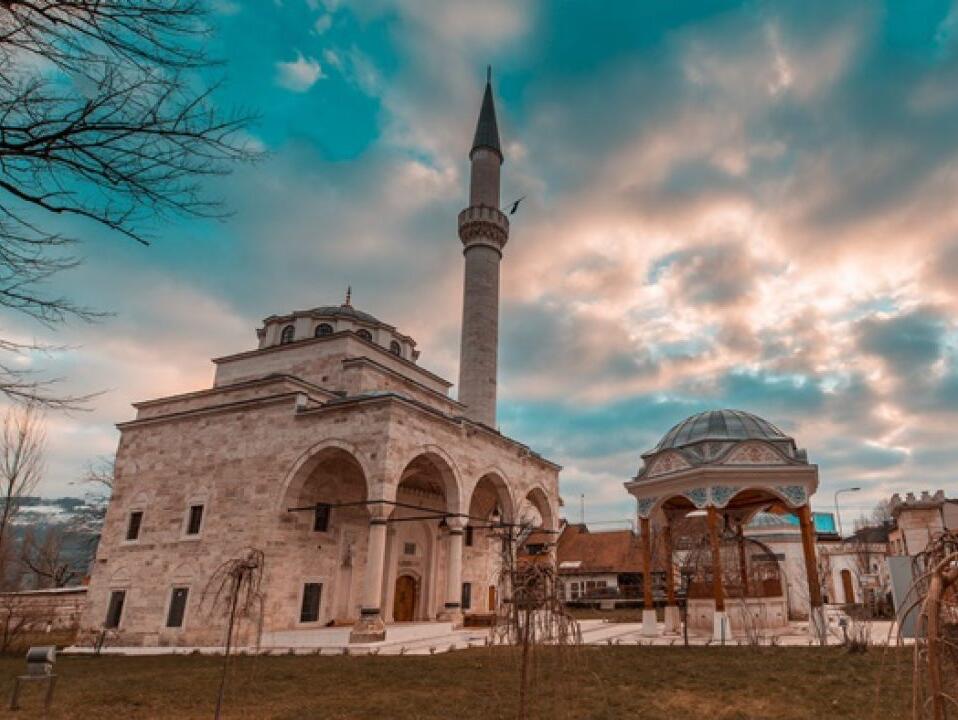
Ferhat Pasha Mosque also known as the Ferhadija Mosque, is a mosque in the city of Banja Luka and one of the greatest achievements of Bosnia and Herzegovinas 16th century Ottoman Islamic architecture. The mosque was demolished in 1993 at the order of the authorities of Republika Srpska as a part of an ethnic cleansing campaign, and was rebuilt and opened on 7 May 2016.
Commissioned by the Bosnian Sanjak-bey Ferhad Pasha Sokolović, the mosque was built in 1579 with money that, as tradition has it, were paid by the Auersperg family for the severed head of the Habsburg general Herbard VIII von Auersperg and the ransom for the generals son after a battle at the Croatian border in 1575, where Ferhad Pasha was triumphant.
The mosque, with its classical Ottoman architecture, was most probably designed by a pupil of Mimar Sinan. There is no written data about the builders who erected the mosque, but from analysing its architecture it appears that the foreman of the works was from Sinans school since the mosque shows obvious similarities with Sinans Muradiye Mosque in Manisa, which dates from 1586.
Hot Springs Srpske Toplice

Gornji Šeher Srpske Toplice since the 1990s, is a local community and a spa town in the area of Banja Luka, Bosnia and Herzegovina. It is located on the banks of the Vrbas River in the southern part of the citys territory. There are eight springs of thermal water in the heart of Gornji Šeher, with a temperature of up to 32°C. Gornji Šeher is designated National Monument of Bosnia and Herzegovina by KONS.
Next to the thermal springs, a spa settlement was created in Roman times. It was located on the right bank of Vrbas, while the road connecting Split with Gradiška which was the Roman provinces of Dalmatia and Pannonia, passed by it on the left bank.
The Ottomans conquered Banja Luka in 1521. The Ottomans established proper settlement here. Around 1580, Ferhat Pasha Sokolović built a bazaar a few kilometers downstream, on the left bank of Vrbas (surroundings of todays Kastel), and in 1583 he transferred the seat of the Bosnian pashaluk there. Since then, Banja Luka had two šehers (towns), Upper and Lower.