Top Theme Image
Top Theme Image

Jacqueline & Kyle

Sunday, October 12, 2025 • Minneapolis, MN

Jacqueline & Kyle

Sunday, October 12, 2025 • Minneapolis, MN

Venue

The Van Dusen Mansion

photo

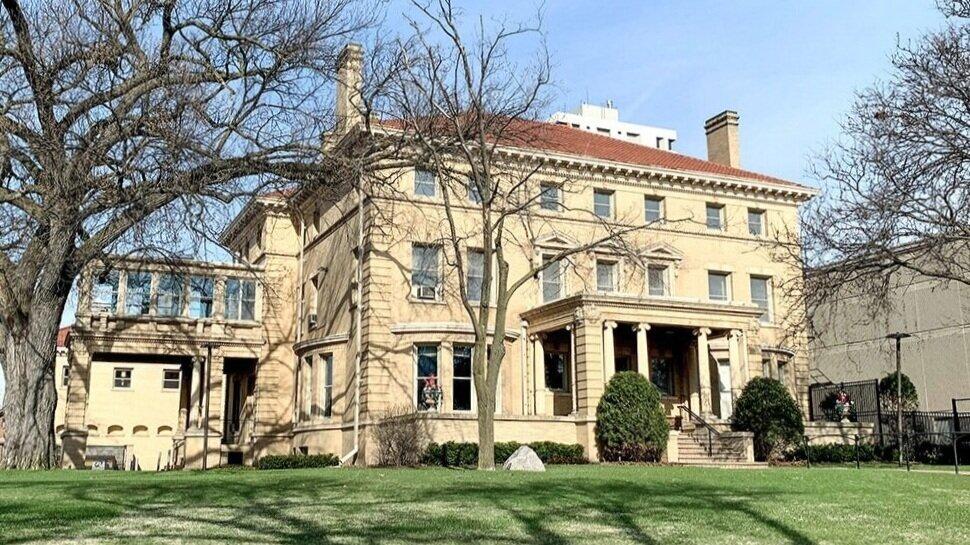
The site of the day's festivities is located at 1900 La Salle Ave in the Stevens Square neighborhood of Minneapolis. The mansion was constructed near the end of the Victorian era in 1893 on what was once the southwestern most edge of Minneapolis. The mansion served as the primary residence of George W. and Nancy B. Van Dusen until 1915. The mansion was listed on the National Register of Historic Places in 1995.

History
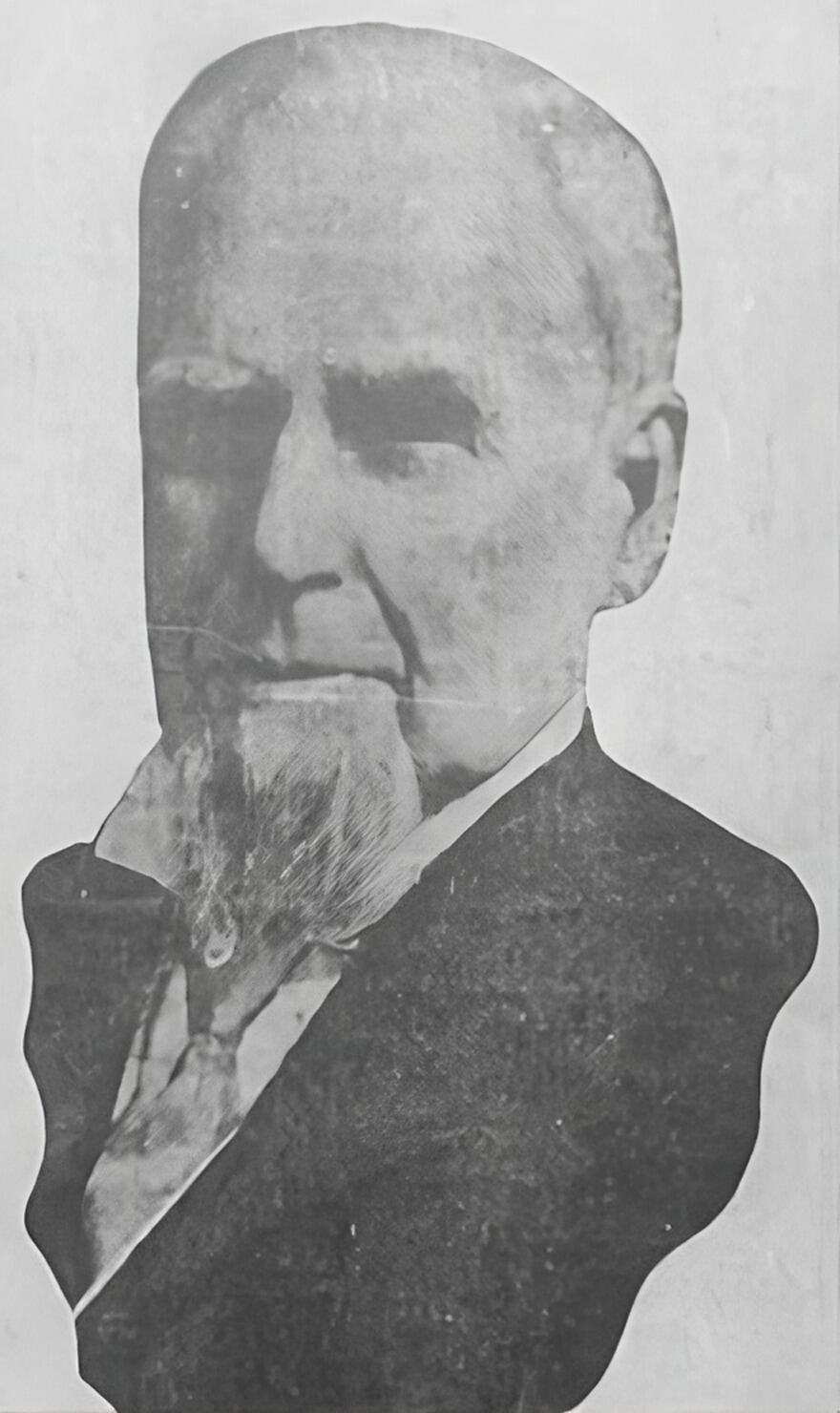
George Washington Van Dusen was born on July 10, 1826 in New York.  In 1852, he began working as a grain buyer in Pardeeville, Wisconsin.  This predated the construction of the  LaCrosse & Milwaukee Railway in 1956 which meant that the grain had to be hauled overland for 90 miles to and from Milwaukee, Wisconsin.

July 10, 1826

George Washington Van Dusen was born on July 10, 1826 in New York. In 1852, he began working as a grain buyer in Pardeeville, Wisconsin. This predated the construction of the LaCrosse & Milwaukee Railway in 1956 which meant that the grain had to be hauled overland for 90 miles to and from Milwaukee, Wisconsin.
George Van Dusen eventually followed the grain trade further west to Roshester, Minnesota where in 1865 he found G.W. Van Dusen & Co.  Through this company he began to construct grain elevators and warehouses along the new rail road lines being constructed in the area.  One of these warehouses was built in a town called Bear Grove which was just west of Kasson, Minnesota.  George Van Dusen is credited with renaming Bear Grove to its present name of Byron after the town of Port Byron, New York where he had once lived.  The name also honor's his father, Laurence, who's birthplace of Byron Center, New York shares a similar name.

January 01, 1865

George Van Dusen eventually followed the grain trade further west to Roshester, Minnesota where in 1865 he found G.W. Van Dusen & Co. Through this company he began to construct grain elevators and warehouses along the new rail road lines being constructed in the area. One of these warehouses was built in a town called Bear Grove which was just west of Kasson, Minnesota. George Van Dusen is credited with renaming Bear Grove to its present name of Byron after the town of Port Byron, New York where he had once lived. The name also honor's his father, Laurence, who's birthplace of Byron Center, New York shares a similar name.
In 1883 George Van Dusen partnered with fellow entrepreneur Charles M. Harrington who eventually headed up Van Dusen business’ Minneapolis office as its president.  The Van Dusen - Harrington partnership was incredibly successful and by 1889 the two had re-organized the company under the Van Dusen-Harrington Company name.  At this point the company was one of the largest grain dealers in the world at its time with around 400 country grain elevators and 50 retail lumber yards.  By 1902 George Van Dusen and Charles M. Harrington were among the wealthiest people living in Minneapolis.

Charles Harrington built his own 30,000 sq. ft. mansion at 2540 Park Avenue which still stands to this day.

January 01, 1883

In 1883 George Van Dusen partnered with fellow entrepreneur Charles M. Harrington who eventually headed up Van Dusen business’ Minneapolis office as its president. The Van Dusen - Harrington partnership was incredibly successful and by 1889 the two had re-organized the company under the Van Dusen-Harrington Company name. At this point the company was one of the largest grain dealers in the world at its time with around 400 country grain elevators and 50 retail lumber yards. By 1902 George Van Dusen and Charles M. Harrington were among the wealthiest people living in Minneapolis. Charles Harrington built his own 30,000 sq. ft. mansion at 2540 Park Avenue which still stands to this day.
George Van Dusen hired the firm of Orff and Joralemon in 1891 to build the Van Dusen Mansion.  The 12,000 sq. ft. mansion's exterior is made of pink Sioux quartzite quarried near Luverne, Minnesota. The roof and turrets are covered with Maine slate.  The mansion is generally within the Richardsonian Romanesque form, but it also has French Renaissance design elements making up its exterior.  The mansion's interior mixes elements of French, Gothic, Tudor, Romanesque, and Elizabethan styles.

One unique design feature of the home was that it was built using I-beam construction methods.  This was done to supposedly make the home tornado-proof as one of the Van Dusen's previous homes was destroyed in a tornado.  The home also includes multiple underground tunnels for potential emergency use that radiate out into the yard.

January 01, 1891

George Van Dusen hired the firm of Orff and Joralemon in 1891 to build the Van Dusen Mansion. The 12,000 sq. ft. mansion's exterior is made of pink Sioux quartzite quarried near Luverne, Minnesota. The roof and turrets are covered with Maine slate. The mansion is generally within the Richardsonian Romanesque form, but it also has French Renaissance design elements making up its exterior. The mansion's interior mixes elements of French, Gothic, Tudor, Romanesque, and Elizabethan styles. One unique design feature of the home was that it was built using I-beam construction methods. This was done to supposedly make the home tornado-proof as one of the Van Dusen's previous homes was destroyed in a tornado. The home also includes multiple underground tunnels for potential emergency use that radiate out into the yard.

Venue Map and Parking

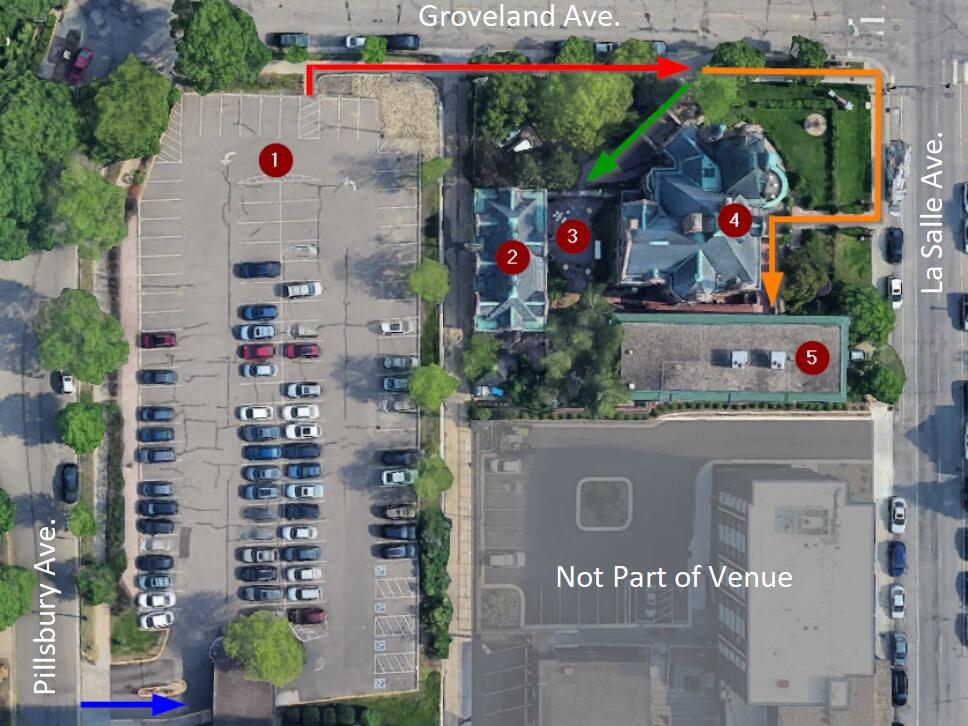
The venue consists of a collection of buildings on the mansion grounds that the evening's events will process through. A dedicated free parking lot for the event with 100 spaces is located adjacent to the venue.


The map below highlights locations of interest and routes to travel to/from the venue.


1. Parking lot

2. Carriage House

3. Courtyard

4. Mansion

5. Ballroom


The parking lot can be accessed from Pillsbury Ave. as indicated by the blue arrow on the map. The venue can then be reached by exiting the north side of the parking lot and traveling down the sidewalk along Groveland Ave. as shown by the red arrow.


Depending on the weather on the day of the ceremony, guests will then enter the mansion grounds either through the courtyard following the green path or the ballroom by following the orange path. The ideal scenario is to hold the ceremony outdoors in the courtyard, but a back up plan is in place to hold the ceremony in the ballroom if the weather is not permitting. Venue staff will be on site to direct guests to the proper entrance on the day of the wedding.
photo

Wedding Flow Map

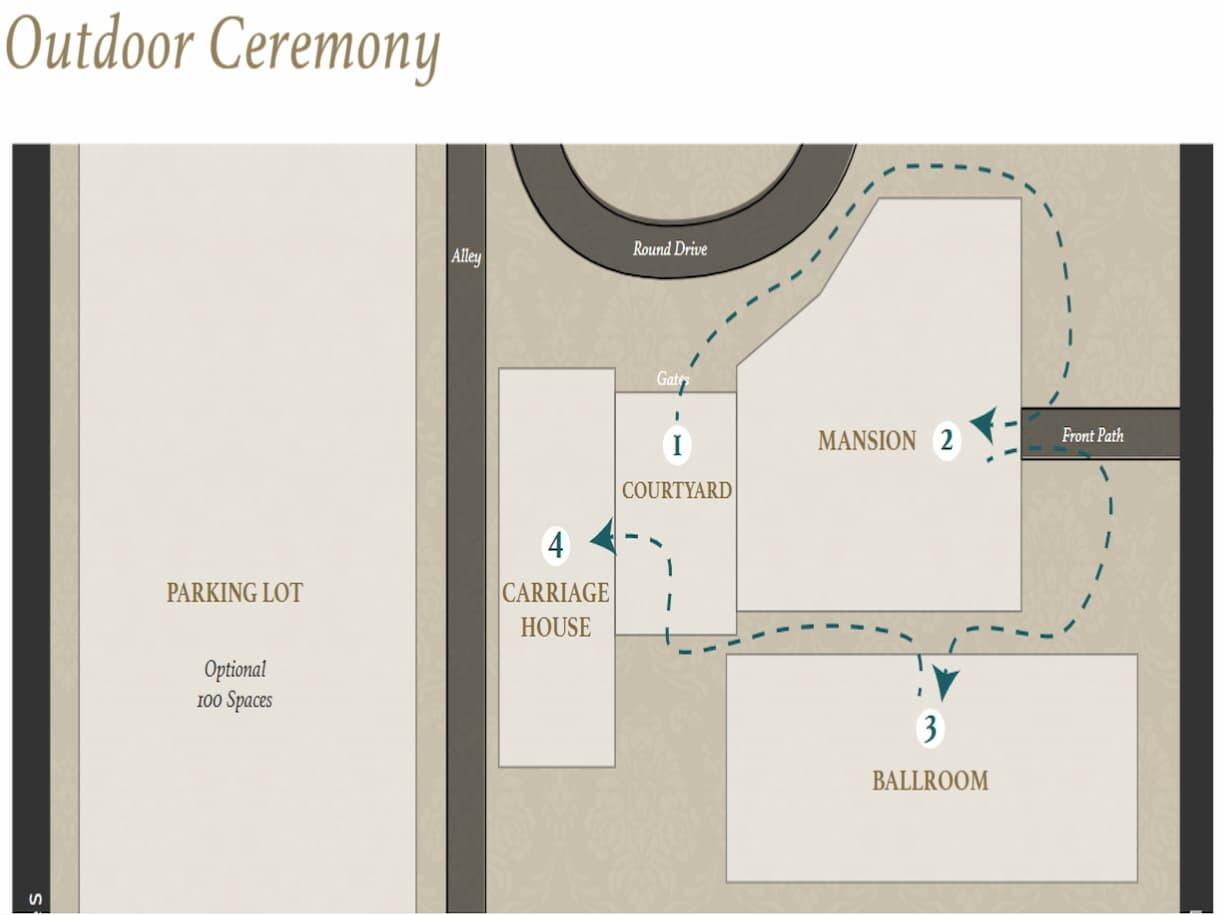
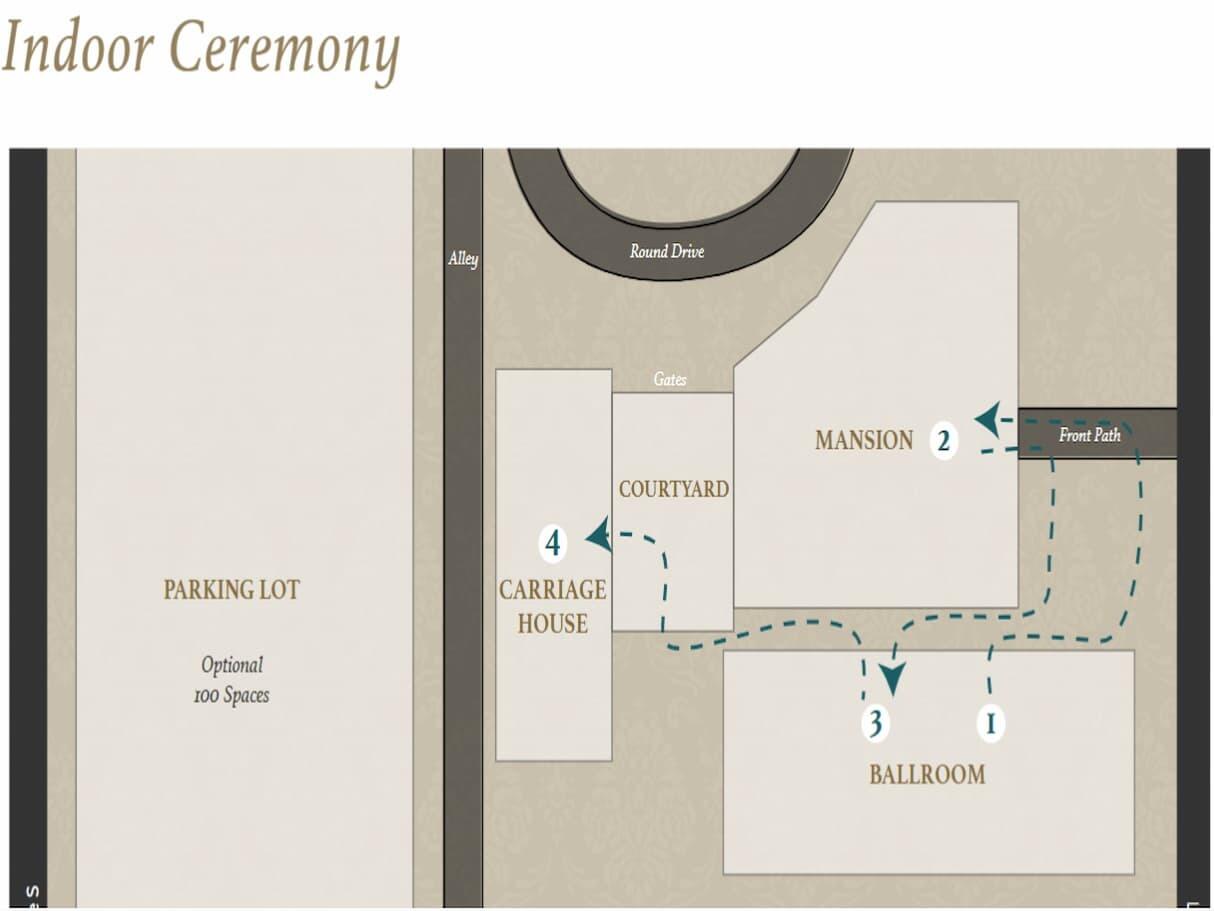
Throughout the day of the wedding guests will be traveling through different parts of the mansion grounds to take part in the wedding's activities. The four main transition events of the wedding include:


1. Ceremony

2. Cocktail Hour

3. Dinner

4. Party Time! (First dances followed by open dance floor)


Venue staff will guide guests between locations at the appropriate times outlined in the wedding day schedule.


Guests will not be able to return to the mansion after cocktail hour or the ballroom after dinner. Any jackets or belongings stored in the provided coat racks upon arrival will be moved between venue locations to follow the wedding guest party. Each of the venue's locations have their own set of bathrooms so there is no need to go back to previous locations.

If weather permits, the wedding ceremony will take place outside in the courtyard to start the wedding day festivities. After the ceremony, guests will be brought into the mansion for a cocktail hour until dinner is ready. Dinner will take place in the ballroom followed by dancing in the carriage house. Guests will be able to mingle between the carriage house and courtyard during the dance. At the end of the day, guests will exit the mansion grounds through the courtyard gates indicated by the green arrow in the previous venue map.
photo

If the weather does not permit for the ceremony to take place outdoors, guests will instead be directed to the ballroom upon arrival. All other event routing through the mansion grounds will remain the same. During dancing guests can either remain indoors in the carriage house or move outside to the courtyard if the weather improves as the day progresses.
photo