Welcome to our wedding website where you can find details of hotels, plans for the weekend, travel ideas, and RSVP pages. Any questions please message us on here or get in touch directly! Sending lots of love, Kayleigh and Jak xxx


Kayleigh & Jak
Kayleigh & Jak
News
News straight off the press!
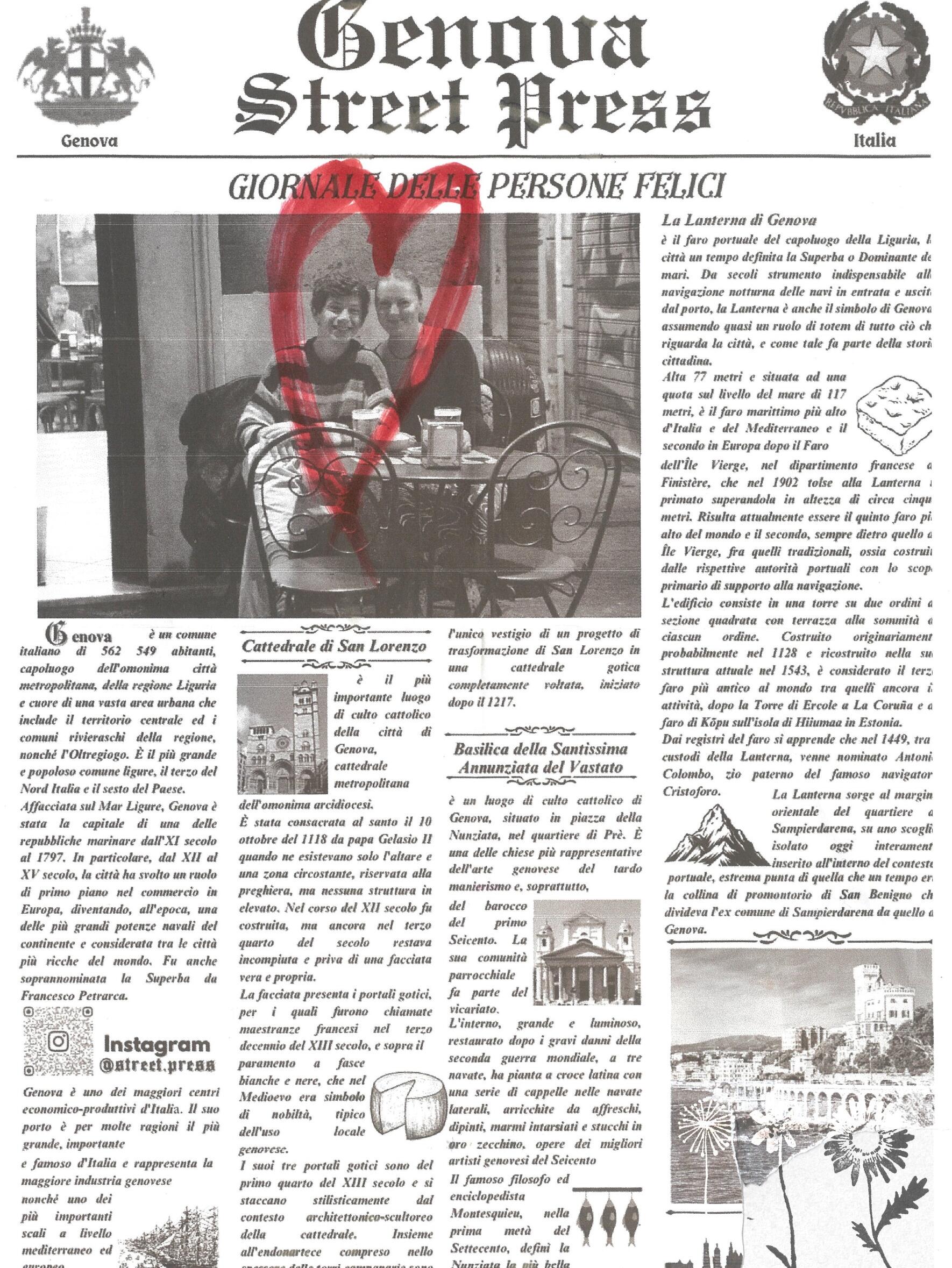
Genova Street Press - History of Genoa
Given to us on the Piazza San Lorenzo outside the Cathedral when we were searching for venues.
JOURNAL OF HAPPY PEOPLE
Genoa is an Italian municipality with a population of 562,549, the capital of the metropolitan city of the same name in the Liguria region and the heart of a vast area that includes the central territory and the region's coastal municipalities, as well as the Ottreglogo. It is the largest and most populous city in Liguria, the third in Northern Italy and the sixth in the country.
Overlooking the Ligurian Sea, Genoa was the capital of one of the maritime republics from the 11th century to 1797. In particular, from the 12th to the 15th centuries, the city played a leading role in European trade, becoming, at the time, one of the continent's greatest naval powers and considered among the richest cities in the world. It was also nicknamed "The Superb" by Francesco Petrarca.
Genoa is one of the major economic and productive centers of Italy. Its port is for many reasons the largest and most important and famous in Italy and represents the largest Genoese industry as well as one of the most important scallop shellfish at Mediterranean and European level.
Cathedral of San Lorenzo
The most important place of Catholic worship in the city of Genoa, the cathedral of the archdiocese of the same name.
It was consecrated to the saint on October 10, 1118, by Pope Gelasius II, when only the altar and a surrounding area reserved for prayer existed, but no elevated structure. It was built during the 12th century, but even in the third quarter of the 11th century it remained incomplete and lacking a true façade.
The façade features Gothic portals, for which French craftsmen were called in in the third decade of the 13th century, and above the facing are black and white bands, which in the Medineva were a symbol of nobility, typical of the Genoese tradition.
Its three Gothic portals date back to the first quarter of the 13th century and stand out from the architectural-seminar style of the cathedral. Together with the endonarthex included in the thickness of the bell towers, they form part of the context of the
Punic vestige of a project to transform San Lorenza into a completely vaulted Gothic cathedral, begun after 1217.
Basilica of the Most Holy Annunciation of Vastato a Catholic place of worship in Genoa, located in Piazza della Nunziata, in the Prè district. It is one of the most representative churches of Genoese art from the late Mannerist period and, above all, the early 17th-century Baroque period. Its parish community is part of the vicariate. The large and bright interior, restored after severe damage during World War II, It has three naves and a Latin cross plan with a series of chapels in the side aisles, enriched with frescoes, paintings, inlaid marble, and stucco work in pure ara, works by the finest Genoese artists of the 17th century.
The famous philosopher and encyclopedist Montesquieu, in the first half of the eighteenth century, defined the Nanziata as the most beautiful church in Genoa.
The Lantern of Genoa
It is the port lighthouse of the capital of Liguria, a city once known as the Superha or Dominante de mari. For centuries an indispensable tool for the nighttime navigation of ships entering and leaving the port, the Lanterna is also the symbol of Genoa, assuming the role of an almost totem representing everything related to the city, and as such is part of the city's history. 77 metres high and situated at an altitude of 117 metres above sea level, it is the highest maritime lighthouse in Italy and the Mediterranean and the second in Europe after the Faro of the Ite Vierge, in the French department of Finistère, which in 1902 took the record from the Lanterna by surpassing it in height by about five meters. It is currently the fifth tallest lighthouse in the world and the second, always behind the Ite Vierge, among the traditional ones, that is, those built by the respective port authorities with the primary purpose of supporting navigation.
The building consists of a two-story square tower with a terrace at the top of each tier. Originally built, probably in 1128, and rebuilt in its current structure in 1543, it is considered the third oldest lighthouse in the world among those still in operation, after the Tower of Hercules in A Coruña and the Kõpu lighthouse on the island of Hiiumaa in Estonia. Two construction records show that in 1449, between Antoni Colombo, the paternal uncle of the famous navigator Christopher Columbus, was appointed custodian of the Lanterna. The Lanterna stands on the eastern edge of the Sompierdarena neighborhood, on an isolated rock now entirely within the porinale context, the extreme tip of what was once the hill of the San Benigno promontory, which divided the former municipality of Sampierdarena from Garllo to Genoa.
The Lantern of Genoa
It is the port lighthouse of the capital of Liguria, a city once known as the Superha or Dominante de mari. For centuries an indispensable tool for the nighttime navigation of ships entering and leaving the port, the Lanterna is also the symbol of Genoa, assuming the role of an almost totem representing everything related to the city, and as such is part of the city's history. 77 metres high and situated at an altitude of 117 metres above sea level, it is the highest maritime lighthouse in Italy and the Mediterranean and the second in Europe after the Faro of the Ite Vierge, in the French department of Finistère, which in 1902 took the record from the Lanterna by surpassing it in height by about five meters. It is currently the fifth tallest lighthouse in the world and the second, always behind the Ite Vierge, among the traditional ones, that is, those built by the respective port authorities with the primary purpose of supporting navigation.
The building consists of a two-story square tower with a terrace at the top of each tier. Originally built, probably in 1128, and rebuilt in its current structure in 1543, it is considered the third oldest lighthouse in the world among those still in operation, after the Tower of Hercules in A Coruña and the Kõpu lighthouse on the island of Hiiumaa in Estonia. Two construction records show that in 1449, between Antoni Colombo, the paternal uncle of the famous navigator Christopher Columbus, was appointed custodian of the Lanterna. The Lanterna stands on the eastern edge of the Sompierdarena neighborhood, on an isolated rock now entirely within the porinale context, the extreme tip of what was once the hill of the San Benigno promontory, which divided the former municipality of Sampierdarena from Garllo to Genoa.