


"I like it when people say, 'How did it last so long?' I say, 'It's still going."
Updated Mar 04, 2025The Kanyadaan Ritual: What It Represents and Who Performs It
Here's what to know about the traditional Hindu ceremony.

Photo: Aileen Photography

Hindu weddings are full of symbolism and meaning, and many of their countless colorful rituals are rooted in ancient tradition. Kanyadaan is one such rite; it represents the moment that both families agree to the marriage—and more specifically, when the father agrees to give away his daughter—and dates back to the Vedic age.
"Kanyadaan is one of the most essential parts of the Hindu ceremony," says wedding planner Umul Vara of Weddings by Vara based in Dallas. Here, she and two other experts—wedding photographer Bhuvana Dhinesh, based in Austin, Texas, and NYC-based Premini Events founder Elizabeth Priya Kumar—help break down the significance of kanyadaan, who can perform kanyadaan and more.
In this article: What Is Kanyadaan? | Kanyadaan Significance | Kanyadaan History | Who Can Perform the Kanyadaan? | How to Plan the Kanyadaan Ritual
What Is the Kanyadaan Ritual in Hindu Weddings?

Photo: Nadia D Photography
There are at least half a dozen rituals that take place during a Hindu wedding. "Kanyadaan is when the bride's parents formally give their daughter away to the groom," Kumar explains. "Besides being a symbolic gesture, it's also a spiritual offering. The father places the bride's hand into the groom's, signifying that she is now his partner in life, dharma and spiritual growth. The priest chants sacred mantras as the bride's hands rest on the groom's, often accompanied by pouring sacred water to sanctify the moment." This ritual is not to be confused with the Roka ceremony, a prewedding ritual that celebrates the union of the couple, often as an extension of their engagement party.
FEATURED VIDEO FROM THE KNOT
Hindu weddings are typically multiday affairs (there's the Sangeet ceremony, the haldi, the mehndi party, baraat and more), and Kayadaan in Hindu weddings happens on the third day as part of the official wedding ceremony, among other rites. "Kanyadaan happens before Mangalya pooja [where the couple] seeks blessing from the God Lakshmi, and mangalya dharanam, the tying of the sacred thread," says Dhinesh. "It takes place at the mandap in front of the guests."
There is a different but similar ritual known as hasta melap. "Kanyadaan is a promise made by the groom's family to take care of the bride, whereas hasta melap signifies the union of the couple, that they are joining hands to become one soul," Vara clarifies. Hasta melap can take place during kanyadaan, or at a later time in the ceremony.
What Is the Significance of Kanyadaan?

Photo: P. Taufiq Photography
As with all Hindu wedding rituals, the kanyadaan meaning is what makes it so important. "Kanyadaan is a ritual where both families formally agree to the wedding," Vara says. "Traditionally, it involves the bride's father giving away his daughter, but we prefer to see it as him inviting the groom's family to share the responsibility of caring for and protecting his daughter." There's a spiritual significance of kanyadaan, too, in that it dates back to ancient texts; performing the ritual is a sign of respect for the culture and religion, as well as for the families.
Kanyadaan History
Hindu wedding rituals hold such significance because of their historical roots; most date back centuries to the Vedic age and have remained largely intact since then. The kanyadaan ceremony is no exception. "Kanyadaan is one of the oldest and most sacred rituals in Hindu wedding traditions," Kumar says. "Its roots go back to the Vedic scriptures, where giving away one's daughter in marriage was seen as the highest form of daan or selfless giving. So when her parents give her hand to the groom, they aren't just offering a blessing, but they are entrusting him with their most precious gift." The importance of kanyadaan is amplified by tradition.
FOR YOU

45 Wedding Entrance Ideas for the Reception
We've done the creative thinking for you.

49 Fun Wedding Send-Off Ideas for Your Final Exit
Time to make your wedding exit epic.
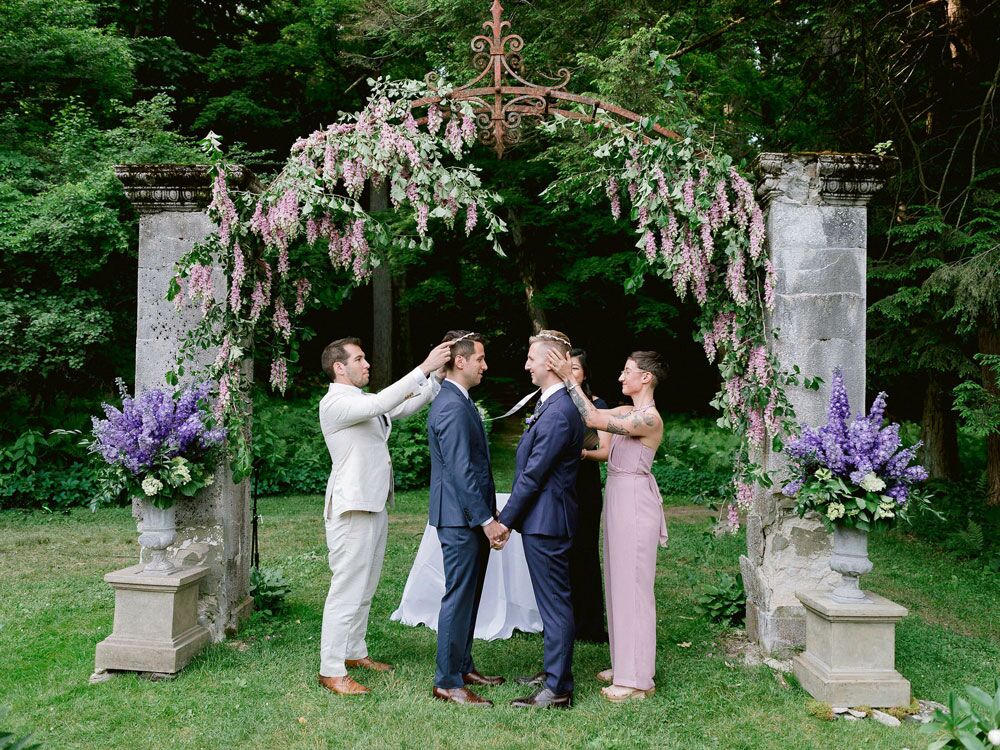
34 Wedding Unity Ceremony Ideas to Symbolize Your Union
Lighting candles and pouring sand are good starts, but there's more where that came from.
Who Can Perform the Kanyadaan?
The ritual of kanyadaan in a wedding is traditionally performed by the bride's father (just as giving away the bride is the father's role in many cultures), but if there is no father, who can do kanyadaan? Can a mother do kanyadaan? Can a brother do kanyadaan? The short answer: yes. "In the absence of a father, a father figure to the bride will perform the ritual," Dhinesh explains. "[Often it's a] paternal or maternal uncle. If the bride has an older, married brother, he is typically given the honor of performing the ritual without considering anyone else."
Especially in the modern day, "what matters most is the intention behind it," Kumar adds. "I've worked with families who chose to honor a late father by involving a maternal uncle or even the bride's grandmother. It's deeply personal and always powerful."
If the bride's father is deceased, he can still be honored or included. "Placing a photo of him in the mandap would be a heartfelt addition," Vara says. (Click here for even more wedding mandap ideas.)
How to Plan the Kanyadaan Ritual

Photo: Bhuvana Dhinesh Photography
For multicultural wedding planning tips, first and foremost, look to an expert who is well-versed in the traditions (check out The Knot Vendor Marketplace to find a specialized planner). On the big day, come prepared. "Make sure you have the key ceremonial items ready: typically a pot of holy water, a coconut, some grains of rice and fresh floral garlands," Kumar says. "These are used to sanctify the moment and are part of the priest's traditional setup."
Vendors should be prepared as well. "Give your photo and video teams a heads-up before the ceremony begins," Kumar suggests. "The kanyadaan is one of the most powerful emotional beats in a Hindu wedding, and capturing that handoff is always a moment to remember." Make sure your audio team is ready, too, with mics and a working sound system. "The mantras and the spoken words between the families can be incredibly emotional, and it makes a big difference when everyone can clearly hear and feel the gravity of the moment."
Finally, feel free to make the moment your own. There are countless ways to do this. "While most of the ceremony is performed seated, doing the kanyadaan ritual standing would be distinct from the other rituals," Vara suggests. Kumar has seen other variations: "There are couples that write personalized vows or include both sets of parents to symbolize mutual unity," she says. "Some brides even pause the ritual to say a few words of thanks to their parents."


