


Spice things up with these steamy flicks.
Updated Oct 14, 2024We've Nailed Down Exactly How Many People to Invite to a Wedding
Your perfect guest count is waiting at the end of this article.

Illustration: Shelby Warwood for The Knot

Let's get this out of the way: There's no universal right answer when it comes to how many people to invite to a wedding. Though, this flexibility doesn't lead to an easier experience when making a wedding guest list. Your number of attendees influences every facet of your celebration (and that's why it's one of the first details to contend with on your to-do list). Of course, it's not as simple as picking a number and rolling with it. Guests cost money and venues only hold a certain number of people. When combined with input from family and friends, the answer to, "How many people should I invite to my wedding?" can feel extra sticky.
Don't worry though, we've got your back with these tips and tricks to land on your golden number. And while who to invite to your wedding is totally up to you, we can help you keep track of invitees' contact info and RSVP status with The Knot Guest List Tool. (If only there was a feature to tell that one pushy coworker that they didn't make the cut.)
In this article: How Many People Should You Invite to Your Wedding? | Number of Wedding Guests Calculator | How to Determine How Many People to Invite to Your Wedding | How Many Extra People to Invite to Your Wedding
How Many People Should You Invite to Your Wedding?
Whether you're envisioning a lavish estate soirée or an intimate ceremony, you'll need to choose how many friends and family members to invite to your wedding day. A good starting point is to get a gut check on the average guest list size and see how you feel about a wedding of that scale. Does the size overwhelm you? Does it feel limiting? This initial assessment will help guide you in a general direction (more than X number or less than X number).
FEATURED VIDEO FROM THE KNOT
Whether it's large or small, the number of guests that you ultimately settle on should be able to accommodate the loved ones you can't imagine your celebration without, suit your overall wedding budget, make sense with your preferred wedding style and be concurrent with your venue's capacity limits.
"Your guest count affects nearly every aspect of your wedding, from emotional impact to logistical planning and budget," says Lara Mahler, founder of The Privilege Is Mine and Altare, and a wedding planner with nearly a decade of experience. "It sets the tone of your wedding, as the number of people you have on your day will dictate whether your wedding is intimate, celebratory or epic. It also drives the budget, the more guests you have, the more tables, centerpieces and food you need, etc. It'll also influence your venue selection, the logistics of table layouts and staffing."
Number of Wedding Guests Calculator
Design: Natalie Romine
While there's no magic wedding guest calculator we can offer you ATM (we're always innovating, though, so who knows what the future holds), this formula will help you determine roughly how many people to invite to a 50-, 100-, 150- and 200-person wedding. Note: These calculations are simply based on the number of folks you should invite to get close to your target guest count and how much you will spend at minimum based on our data for the average cost per guest. Because budget and style are so subjective, it's tough to provide an ultra-customized perfect number for everyone, but you can use this calculation as a guide. If you'd like some more help with hashing out your wedding aesthetic and an appropriate budget, poke around The Knot Style Quiz and The Knot Budget Advisor for some deeper, more personalized insights.
Below, see some quick guest-list math based on drop-off-rate data provided by Mahler and average-cost-per-guest data from The Knot 2025 Real Weddings Study:
- If your ideal attendee count is 50 guests, make an invite list of 57–62 people. Plan for a minimum budget of $14,200.
- If your ideal attendee count is 100 guests, make an invite list of 115–125 people. Plan for a minimum budget of $28,400.
- If your ideal attendee count is 150 guests, make an invite list of 172–187 people. Plan for a minimum budget of $42,600.
- If your ideal attendee count is 200 guests, make an invite list of 230–250 people. Plan for a minimum budget of $56,800.
Remember: This data should be used as a base guideline—and you know your loved ones best. For example, if you're the type of person who truly does have 50 ride-or-die folks who would never miss your wedding come hell or high water, stick closer to your ideal number and don't over-invite. Also, ALWAYS ensure your venue can accommodate every single person you invite if they all happen to RSVP affirmatively. Sending your invites out in two waves—not all at once—can help you figure out how many people to invite overall (more on that later).
How to Determine How Many People to Invite to Your Wedding
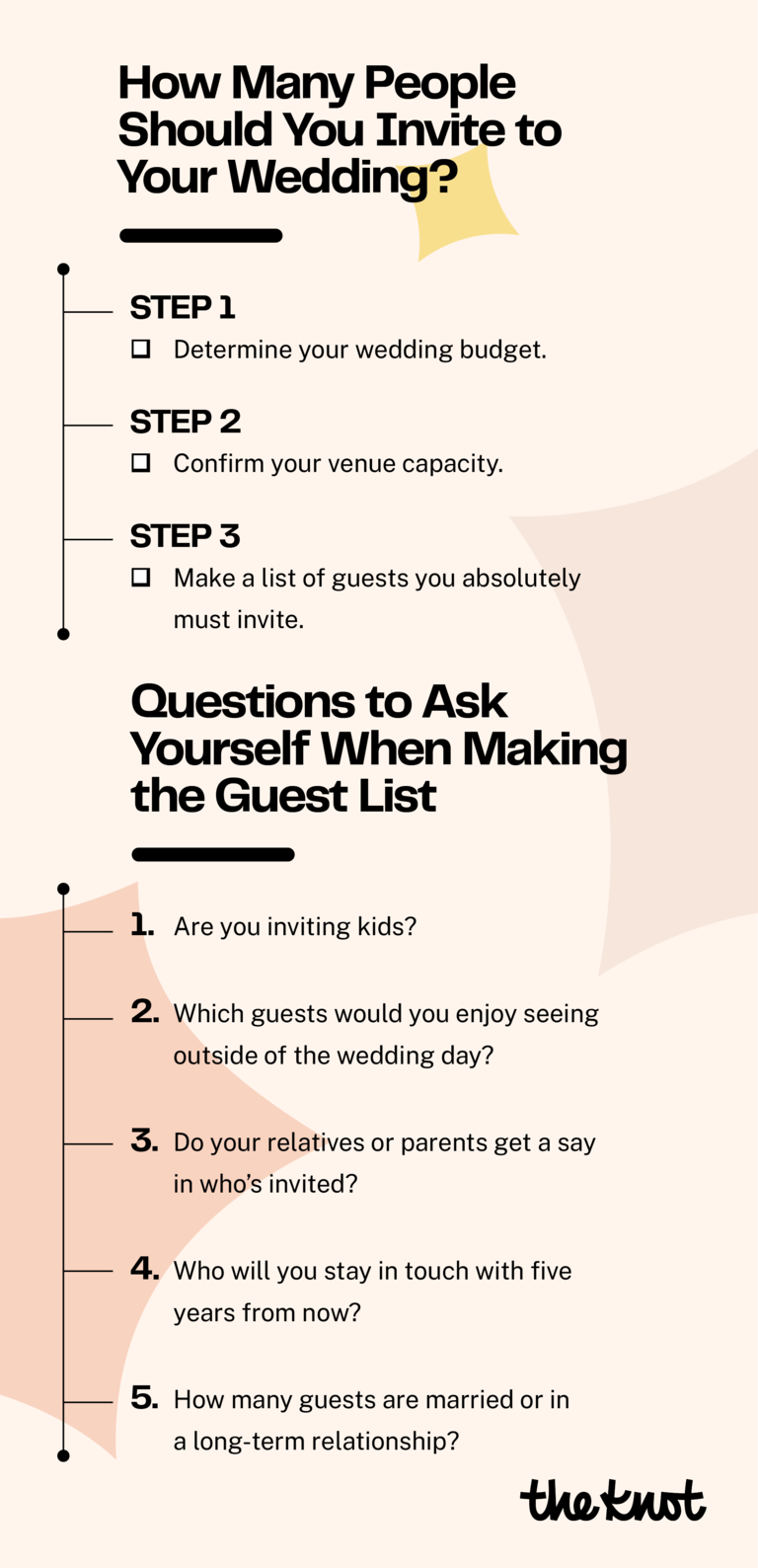
In an ideal world, everyone you love would be invited to your wedding, but it's totally okay (and normal) if that's simply not doable for you. When deciding how many people to invite to your wedding, it's up to you to figure out what you're willing to sacrifice. For some couples, that could mean cutting back on flowers and decor in order to maximize their budget and invite more people. For others, having more financial wiggle room for personal touches and wedding splurges is a priority, even if it means keeping the guest list tight. We're outlining a few factors here that influence how many people are invited to a wedding:
FOR YOU

The Best Wedding Planning Tools & Resources Available
Fun and free wedding planning tools? Yes, please!

Your Guide to Hiring a Wedding Babysitter Near You
Having an adults-only wedding? Provide the ultimate guest amenity by hiring a sitter for the kiddos.

Wedding Dress Code Wording That Makes Sense
It's time for a dress code decode.
Venue Capacity
Most venues have headcount minimums and maximums—in other words, they need a certain number of guests to host your event, but that number can't exceed their limits for safety or noise reasons. This is the most significant factor when it comes to how many people are usually invited to a wedding. Ensure you never invite more than your venue can handle (even if some of those guests come from a B-list) and that you're well beyond their minimum to account for any potential no-show wedding guests.
"I always recommend for my couples to create an ideal list, not leaving anyone out, and seeing where they land," says Mahler. "Depending on venue capacities, they can adjust their guest list as needed and then create multiple lists and use the A-list and B-list approach." Don't forget to abide by proper plus-one etiquette for relevant guests and wedding party members as you make this master list.
Wedding Budget
The funds you have available for your nuptials directly impacts the number of guests you can afford to host. Evaluate your wedding budget (along with any financial contributions from family members) to get a general understanding of how that number matches up with the prices of venues you're eyeing and their guest capacity. The larger the guest list, the more money you'll have to spend on items like catering, invitations and event rentals. Can you realistically afford to host the number of people you envision?
Keep in mind, your cost per guest can be influenced by a number of factors, such as your region, the kind of venue you want and your overall vision. (If you only want an intimate backyard party, for instance, your guest list count and cost per head could be much lower.)
Preferred Energy and Vibe
Practical factors aren't the only wedding elements that influence guest count. The amount of revelers you have toasting and dancing the night away deeply alter the mood and energy of your celebration.
"A small wedding with 50 guests or less can give off an intimate, calm and emotional feel—it can feel more personal and heartfelt, like a gathering of close friends and family," says Mahler. "It can definitely feel low pressure for the couple and the vibe might feel more like a dinner party, depending on the setting." The expert notes that a mid-sized wedding has a balanced energy between lively and grounded, offering a warm and celebratory feel without getting overwhelming. "It has a good mix of intimacy and excitement, and there are enough guests to create buzz on the dance floor, but still be manageable." A big bash of 120+ guests will be incredibly buzzy and ultra-celebratory with a packed dance floor throughout the night. Though, a larger guest count will make your celebration feel less cozy.
Desired Interaction Time With Each Guest
Does your wedding vision entail you getting cozy at each table, taking a moment to truly connect with each attendee? Or is it more like you have a fun moment on the dance floor with various groups of guests, reveling in the party energy as a collective? If the former, a smaller, more-tailored guests list (likely under 60 guests) is best for you. If the latter, invite 100+ loved ones to show up and show out for you. Smaller weddings will give you more one-on-one time with each guest, but regardless of your guest list size, you should still be intentional about who you invite. Mahler invites couple to consider the following:
-
Do we genuinely want this person there, or do we feel obligated to invite them?
"Obligation could come from family, or whether or not you were invited to their wedding," says the expert. -
Have we spoken to this person in the last year—and would we choose to spend personal time with them now?
"This question helps filter out distant acquaintances or people from 'a past life' who no longer have a meaningful presence." -
Would we feel disappointed or sad if they couldn't make it?
"A simple, but revealing gut check," says Mahler. "If the answer is 'not really,' that may be a sign they don't need to be on the list." -
Are we inviting this person because we want to—or because we think we should?
"The word 'should' is a red flag. It usually signals you're stepping outside your true priorities and giving into external pressure."
How Many Extra People to Invite to Your Wedding
How many people do you invite to a wedding? Honestly, a few more than you might think you want. Mahler says it's typical for couples to have a B-list of wedding guests to extend invitations to if their venue has a capacity minimum they must meet, as there's only a certain percentage of wedding guests who RSVP "yes."
"If you invite 100 guests, you can expect 75–85 to attend," says Mahler. "In that case, you'll have space to send our additional invites to a B-list. If you're going to do this, I recommend sending your A-list 16 weeks out, give them a month to RSVP and, if you start to see folks RSVP 'Not attending,' then you can start sending B-list invitations out." Sending your A-list invites and RSVP deadline early will allow you to send B-list invites in a way that won't make guests feel like they're last-minute additions. Keep the B-list RSVP date a full month ahead of your wedding to not rush their decision. Additionally, it's smart to order a few more invitations than you need to accommodate any last-minute guest additions. The Knot Invitations has a slew of stunning designs at affordable prices (and the price per invite gets lower the more you order).


