


Spice things up with these steamy flicks.
Updated Oct 14, 2024The Marriage Market: How the Economy's Changed the Wedding Landscape
One asset that'll always appreciate: your love.

Photo: Stocksy

We'd be living in a "wedding bubble," so to speak, if we didn't acknowledge that the global economy comes into play with weddings. A marriage is an investment in your relationship. And a wedding is, well, an investment. (A worthy one, at that—when else can you hug all of your loved ones in just a few hours?) While the emotional value of throwing one has remained high, the level of spend has varied over the years. Below, we take stock of the evolution of wedding costs, how the broader economy has shaped them, what couples pay and other money matters, backed by insights from financial experts. Rest assured, though: We'll always be bullish on celebration.
Meet the experts:
- Ashley Bleckner, MA, CFP, CDFA, is a managing director and private-wealth advisor at Ellevest. She has over a decade of experience in the financial-services industry and advises individuals, families and foundations on public and private market investing, transitions of wealth and sustainable investing.
- Sam Bourgi is a senior finance analyst at InvestorsObserver. He has a background in economics and public policy, with an initial focus on monetary policy and macroeconomics.
- Sara Faurer is a private wealth-management financial advisor at Ellevest. Previously, she worked at Goldman Sachs, investing for ultra-high-net-worth families, individuals and institutions.
Investment Advisory: Wedding Budgeting Tips
Follow the expert-backed tips below to stay on budget in the face of economic upheaval.
1. Stay Anchored in Your Priorities
"Start by identifying the two or three elements that matter most to you—for example, guest experience, photography or location—and allocate more of the budget there, while intentionally spending less elsewhere," says Bourgi. Making this decision an active discussion with your partner is essential, Faurer adds, to see where you align and differ. She recommends making two lists: areas to splurge on, and areas to save on. "Planning a wedding feels like boarding a train that eases out of the station initially but picks up speed quickly, and before you know it you've lost control," she says. "Come back to your wedding priorities in moments of spend creep, and remember what you deemed important and unimportant."
2. Add Some Cushion
"Build in a 10% to 15% buffer," says Bleckner. "Every wedding has at least one 'wait, that costs how much?' moment." Use the average cost of a wedding as a benchmark.
3. Nail the "Who"
"Communicate and determine who's paying for what early and explicitly," says Bleckner. "Yours, mine, ours, parents, future you—clarity now avoids resentment later." Bourgi adds, "Decide early how costs will be shared. Whether expenses are split evenly, proportionally to income or supported by family contributions, this wedding budget breakdown should be clearly communicated up front."
FEATURED VIDEO FROM THE KNOT
4. Set Up a Payment Schedule
"Outline a budget and communicate with any contributing parties, then establish a payment schedule for everyone who's providing dollars throughout the planning process," says Faurer. "Most vendors require an up-front deposit, and the balance is paid closer to the wedding date. Communicating in advance will help avoid cash-flow issues as you go."
5. Remember the Guest-Count Effect
"Align on guest count early in the planning process," says Faurer. "This is a key driver of cost and can have a big impact on setting a budget."
6. Define the "Why"
"Name your 'why' before throwing numbers in a line item," says Bleckner. "Is this about celebration, family, aesthetics or ease? The budget should follow the couple's values, not the latest trend on TikTok."
7. Start Early and Keep It Real
Bourgi recommends setting your budget ASAP, so costs don't start adding up before you have a game plan. Also crucial: being okay with compromises. "Setting realistic expectations from the start is key," he says. "For example, if wedding expenses are substantial, it may make sense to delay the honeymoon to avoid taking on another large expense at the same time." Bleckner agrees: "Keep in mind the postwedding financial hangover. This can include the honey moon, moving and potentially merging finances, and often hits right after."
Beware of Budget Blind Spots
Account for these often-overlooked categories when making your OG wedding financial plan.
- Wedding party gifts: Presents for your people should be prioritized.
- Wedding insurance: You've got to spend a little money to ensure your investment is secure.
- Thank-you notes: Your stationery spend will encompass more than just invites and save-the-dates.
- Signage: Bundle the price of your welcome sign and bar sign into your decor budget.
- Vendor tips and fees: Some are set at a recommended dollar range, but 15% to 20% is the typical tip rule of thumb. Also account for service fees and outside vendor fees, if applicable. And read all contracts carefully, so you know your full scope of spend.
- Attire alterations: Your 'fit needs to fit, so reserve around $1K minimum to have on hand for tailoring.
A Macro View on What's Affecting Wedding Costs
Weddings don't happen in a vacuum—in fact, the industry brings in billions per year. All's to say they're beholden to broad-scale economic shifts, just like everything else. According to The Knot 2026 Real Weddings Study, 63% of couples' budgets were affected by the current economy. Here's the TL;DR from our experts on the major players affecting wedding costs, and how much $$$ couples set aside.
Inflation
Bourgi notes that the recent inflationary period that began in 2022 and proliferates today has caused costs to rise. "Elevated inflation has significantly increased venue, catering and service costs compared to even a few years ago," he says. "Cumulative inflation for everything is up around 26% since 2020, give or take. Certain categories are higher, like food." This includes flowers, rentals and general labor costs—which means quotes have the potential to shift drastically and quickly, leading many couples to lock in vendors early to avoid potential price upticks in the future.
Unsurprisingly, The Knot 2025 Economic Pulse Study found that inflation is top of mind for economically concerned soonlyweds. Among couples who cited the economy as their top concern, 81% were worried about inflation's overall impact on their finances, while 74% were specifically uneasy about the rising cost of wedding related goods.
Supply and Demand
Whatever the economic climate at any given time, this principle is always at play. "Peak wedding months, popular venues and limited vendor availability drive prices higher," says Bourgi. "If you're getting married in peak season, you'll have to book further in advance, and the cost will be higher."
Additionally, the labor shortages and backlog of postponed events during the pandemic created "pent-up demand," he says, which pushed prices higher once the industry was back in full swing. Many of these elevated costs still proliferate today.
Supply-Chain Disruptions
When the flow of goods is interrupted, it results in 1) higher costs for remaining goods and services; 2) delays in getting goods to their next stop (think flowers to your florist); and 3) difficulties in getting materials to make goods, such as the fabric for a wedding dress. Supply-chain disruptions skyrocketed during the pandemic, and the ripple effect is still seen today. "It feels like there was a world of wedding budgets prepandemic, and an entirely different world of wedding budgets postpandemic," says Faurer.
Interest Rates: "Higher rates make borrowing more expensive," says Bourgi. "This matters if couples are using credit cards or personal loans to fund part of the event."
The "Experience Economy"
It's booming, especially postpandemic, as folks are willing to invest in events that build connection and evoke feeling, like a wedding. In turn, couples are more likely to splurge on details that make their celebration special, even if they're beyond their means.
Social Media
While not a classic economic factor, this was cited by multiple experts as a significant driving force behind heightened wedding spend, starting in the 2010s. "Social trends have done a lot to influence everything about weddings, from prewedding showers and extravagant bachelorette parties to all-weekend festivities," says Faurer. Bourgi adds: "Platforms like Instagram increased demand for highly curated, visually driven weddings, raising expectations and costs."
Stock Up: Wedding Costs Over Time
See how much couples have invested in key wedding categories since 2019 according to The Knot Real Weddings Study, and how those numbers have changed over the years amidst the significant economic volatility since then.
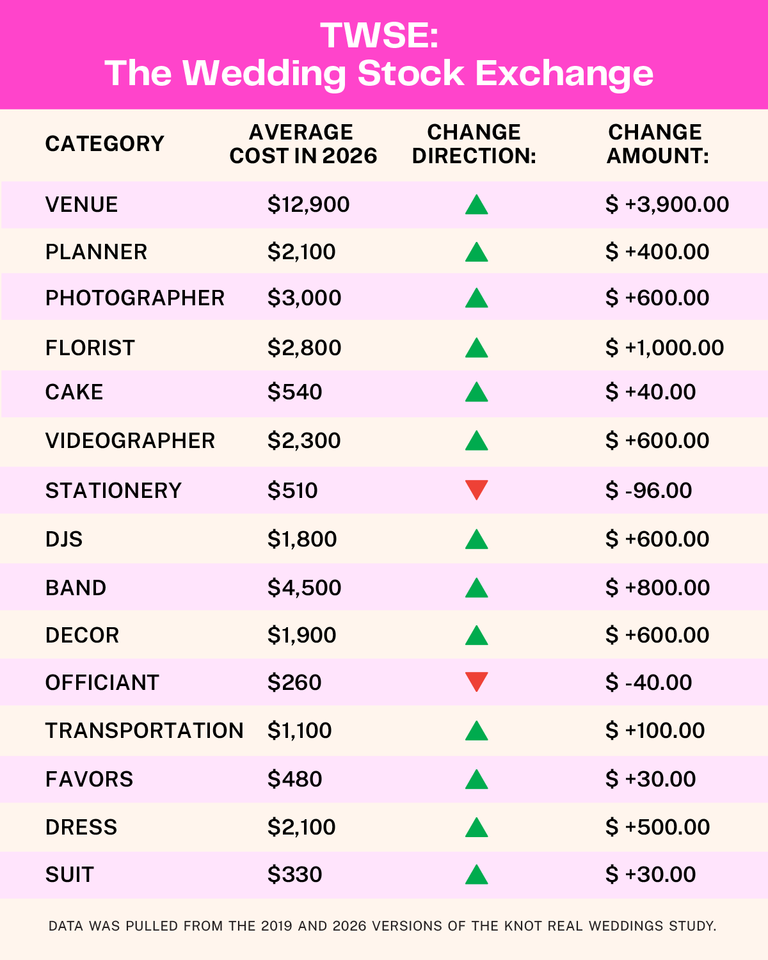
Design: Tiana Crispino
A version of this article first appeared in The Knot Magazine 30th Anniversary Issue in Spring 2026.


