


Spice things up with these steamy flicks.
Updated Oct 14, 2024Down Memory Aisle: A Wedding Retrospective of the Last Three Decades
A look back at how we celebrated love over the last 30 years.

Photos: Stocksy, Getty Images,Illustrations: Mariana Rodrigues,Design: Tiana Crispino

Imagine if we had one big photo album containing every set of nuptials from the past three decades—a 30-year wedding retrospective: We'd see puff-sleeve gowns give way to sleek slips, then blinged-out mermaid cuts, then the now ubiquitous Basque-waist dresses. We'd watch flowers go from cascading to structured to hyper seasonal, and photography transition from film to digital and back again. We'd witness the rise and fall of the Mason jar, and the triumphant return of the disco ball. And whatever your thoughts on if your cousin's early-2000s wedding would hold up today, you probably learned a thing or two from it about how you do (or don't) want to celebrate your own nuptials.
That's the core of what's emerged over these last 30 years in the wedding world: Couples feel empowered to personalize their celebrations to reflect how their loves and lives feel, whether that means following tradition, tweaking it or bucking it fully. The canon is rich, and there'll always be an inherent nostalgia to these events, no matter what decade they take place. After all, a milestone like marriage doesn't exist in a vacuum—it connects us with past and future generations, as well as those around us in the many moments of celebration that come with it. So before we look ahead to the next 30 years of weddings, it pays to see how far we've come, decade by decade.
1996–2006
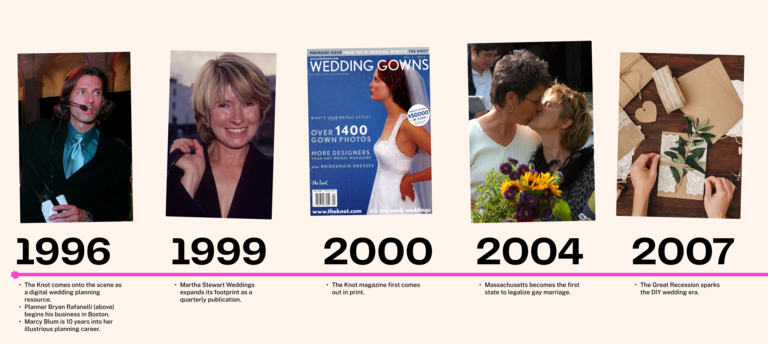
Thirty years ago, the wedding industry was just starting to shake off the frilly trappings of the 1980s, though that's not to say things felt any less formal. This era ushered in the precision of execution we see today, and with that came full-service wedding planners.
"Our expertise has grown exponentially, and the jobs of designer, social secretary and wedding planning producer all melded into one," says luxury wedding planner Marcy Blum, a fixture in the industry for four decades. The transition through the new millennium was all about symmetry and achieving a level of elegance that read as sophisticated and refined. Think polish above personalization, with tradition and "hosting well" taking priority over uniqueness.
FEATURED VIDEO FROM THE KNOT
"This era was rooted in formality and tradition," says wedding and event planner Bryan Rafanelli, who began his career in 1996. "Weddings were structured, ceremonial and guided by long-standing norms. The gathering itself followed a clear script." Ceremonies were often held in religious institutions, while receptions unfolded in venues that were already primed to host weddings, like banquet halls and hotel ballrooms.
Florals were lush (often appearing in white or pastel shades), with roses and lilies taking center stage. And while some bouquets cascaded, others skewed monofloral and minimalist, with lilies of the valley particularly favored. Carolyn Bessette carried a bunch of the delicate white blossoms during her intimate 1996 wedding to John F. Kennedy Jr., as did model Stella Tennant, the granddaughter of Deborah Cavendish, Dowager Duchess of Devonshire, in her 1999 nuptials.
The Bessette-Kennedy trendsetter, now the subject of FX's Love Story, also ushered in another defining style of the late '90s: sleek minimalism, a chic, effortless and simple aesthetic epitomized by Bessette's sleeveless slip dress. The "cool bride" of that decade in terms of fashion was easy and breezy, as also demonstrated by the mini dress Cindy Crawford donned at her 1998 beach nuptials. Still, a slightly streamlined iteration of the cupcake-like princess gown held on. (Think Cameron Diaz in 1997's My Best Friend's Wedding.) Blum says that this period of wedding planning was generally "very female-centric," with not much consideration given to grooms.
However, marriage and family historian Stephanie Coontz notes that, despite the continued imbalance of the planning workload, there was an undercurrent of equality bubbling up that proved pivotal in creating more intentional marriages.
"The 1990s were a time of rapid change in the predictors of marital success," says Coontz, who attributes this shift to queer couples dissolving traditional gender roles. "From the 1950s through the 1980s, when a woman had more education or earned more money than her husband, that was a risk factor for divorce. And couples in which women did the bulk of housework and cooking reported being happier and having more sex. All that got reversed in the 1990s."
On the cusp of the aughts, print publications were in their heyday—especially wedding magazines. Martha Stewart Weddings hit newsstands as a quarterly publication in 1999, and The Knot magazine debuted in 2000.
"All of a sudden, middle-class brides across the country were learning about Vera Wang—her iconic '90s wedding dresses were so dreamy—and Monique Lhuillier before they even entered a bridal salon," says writer Cate Doty. "The details from a Martha wedding, for a certain class of bride, were important: ribbons on chiavari chairs, bespoke wedding stationery, anemones and ranunculus, pale blue sashes and long rows of satin-covered buttons. Those things can feel like table stakes now, but 30 years ago they felt fresh and new."
Celebrations scaled back slightly in the wake of 9/11, but weddings gradually swung back to being bigger bashes in the following few years. And while they still retained some classic elements, the early 2000s redefined what qualified as elegant.
"When I started, a nice wedding was a church ceremony, some bridesmaids in matching dresses and a dinner at the country club," says Doty. But the 2000s brought flash: Colors got brighter, the strapless ball gown peppered with pickups began to gain traction, tents were the new big thing and everything was getting a little bling.
Design: Tiana Crispino,Photos: The Knot, Getty Images
2006–2016
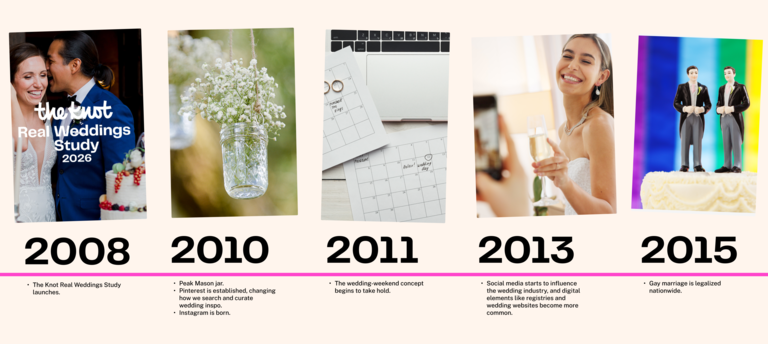
The fairy-tale era was officially underway in weddings of the mid-2000s, with veils flowing from tiaras, sweetheart tables set up with throne-like chairs and the overall notion of luxury at the forefront. Celebrations were now about formality and scale, but still most likely to take place locally. The concept of "bride-as-princess" was no doubt sparked in part by the 2007 premiere of Say Yes to the Dress—viewers could yell at their TVs with the gusto of sports fans and clutch their pearls along with Randy Fenoli when brides requested a "sexy" gown. The program soon spurred the development of other wedding-centric reality shows that helped herald in the idea of nuptials as a spectacle or experience, rather than just a milestone.
Couples of this time were starting to crave personalization and differentiation: "The decade marked the beginning of intentional personalization," says Rafanelli. "Couples began redefining the guest experience—choosing destinations, rewriting timelines and shaping events around shared interests and relationships."
But while this stretch kicked off with sparkle, the Great Recession between 2007 and 2009 brought budgets back down to earth. And that, paired with a newfound desire for more unique weddings, launched the DIY boom. "I got married two years after the Great Recession, and DIY had become huge," says Doty. "The opulence of early-aughts weddings—which I covered—was, for a time, overtaken by Mason jars and Etsy finds. And then the opulence merged with the Mason jars, and we ended up with fancy Mason jars." The rise of this decor icon came along with the ascent of the barn wedding, as well as an embrace of rustic elements: sunflowers, tasteful burlap, cowboy boots worn with gowns.
The swing to DIY was an economic necessity for many, but around the same time, a major power player appeared that would empower couples who wanted a significant hand in creating their own wedding visions (and vision boards). Pinterest first popped onto the scene in 2010, and soon was offering a wellspring of inspiration for couples to assemble into infinite mood boards depicting their ideal celebrations.
And while the aforementioned barn may have been the venue du jour, other locales previously deemed untraditional were cropping up too. The classic church ceremony was often swapped for an alfresco "I do," and guests danced the night away everywhere from vineyards to breweries, all now fixtures in the wedding-venue world. Along the same lines, this was also the time of getting experimental with desserts. The fondant-cloaked confections that had been popular gave way to cupcake towers, naked cakes and donut walls.
Pinterest wasn't the only technological advancement influencing planning during this decade, either. The early stages of today's ubiquitous wedding websites and online registries were taking hold, making it easier than ever to relay details to guests. And Instagram heralded in a new way for couples to put together and share their nuptials. While Facebook, introduced back in 2004, had worked for a wedding-album photo dump (if you even felt like having one), Instagram encouraged curation and raised the stakes—especially during this pre-carousel time, when the ratio was just one photo per post.
Toward the end of this era, splashier celebrations were back on the docket, with social media sharing a fixture in couples' minds as they planned. The period also saw the growth of destination weddings, grandiose second weddings and the wedding weekend, according to Blum. Bloggers were beginning to blossom into social-media influencers and, in turn, the standard for wedding photography was elevated beyond planned poses and simple smiles.
Perhaps the most important wedding milestone in history closed this 10-year span: Gay marriage was legalized in the US in 2015—a boon for all couples, Coontz notes, as it helped blur the gender roles in wedding planning and model true equality for all. The future was bright—even if everyone was probably already a little sick of succulent centerpieces.
Design: Tiana Crispino,Photos: The Knot, Getty Images
2016–2026
We now enter what we're calling "the decade of details." Weddings today are fully seen as expressions of the couple, not formulaic events. The late 20-teens brought a bevy of out-of-the-box elements: Eucalyptus and pampas grass were the floral fillers of the moment (often dispersed among tonal, berry-colored blossoms), and bouquets began to skew less structured. A vintage-boho theme evolved from the rustic weddings of previous years, bringing with it triangular wedding arches, crochet and macramé, and piecey, low-swept updos with decorative braids.
On the flip side, glam was the new take on traditional, encompassing gilded details, tufted furniture and clouds of manicured roses—not to mention the birth of the gilded-mirror seating chart and *that* script font. Cultural details (like, perhaps, threading marigolds through a wedding bouquet to nod to a marrier's Indian heritage) began to appear in creative ways within wedding designs—every element requiring thoughtful selection.
"Broad-scale, it's gotten even more curated and personalized. The industry itself has grown in its ability to cater to more cultures and religions," says Doty. "I can guarantee you that 30 years ago, not many couples gave much thought to every single last detail, from guest books to place cards to welcome baskets—which were not even a thing then. There wasn't as much variety and choice."
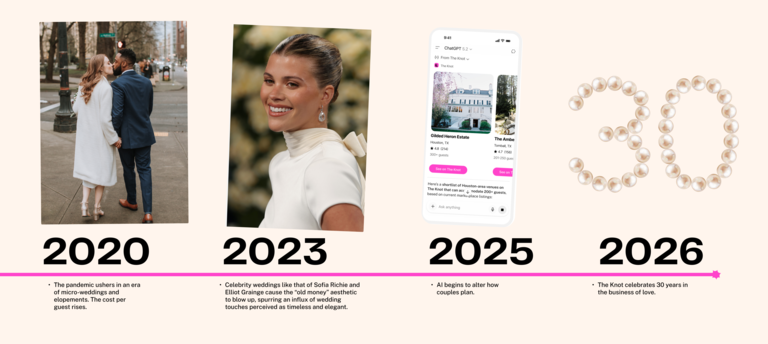
Guest experience also emerged as a top priority (cited as such in The Knot Real Weddings Study every year from 2019 through the present); Blum notes that the standards for guest-centric elements like food and entertainment have risen significantly. In the same vein, less tangible and more experiential options began to appear on registries in lieu of the staid kitchen appliances. Cash funds and honeymoon activities ascended the ranks, while the appearance of wedding china on registries fell from 28% in 2013 to 11% in the past few years, according to The Knot Registry Study.
Of course, a significant reason for this change in the registry landscape can be attributed to the increase in couples living together before marriage, a factor that's also caused a shift in perception of the celebration itself. "It's certainly changed what the wedding represents," says Coontz. "It's seen less as the beginning of a seriously committed relationship than as a celebration of the achievement of such a relationship."
Come 2020, the COVID-19 pandemic triggered a movement of more-petite parties, which then pendulumed back to big celebrations. "I'm seeing larger bashes now versus 10 years ago," says Blum. "Micro-weddings were popular because of COVID, and sometimes for other reasons, like the couple wants to go to Europe to wed but can't have a party there."
And with weddings in full swing again, party energy has entered its prime, with over-the-top details like Lambeth cakes, disco balls, champagne towers and tons of color becoming modern hallmarks: "Everything is bigger and better," says Blum. Elaborate welcome parties are now staples of the wedding weekend, as are splashy after-parties, and many marriers will (or at least will feel pressure to) show off a new all-white look for each event.
"These days, it feels like nothing is too much—we're truly back in the days of the Gilded Age when it comes to weddings," says Doty. "But now even that feels a bit quaint. Now it feels like the sky's the limit." Social media is inextricably woven into the fabric of weddings, from expectations set (without much explanation of cost and effort) by the elaborate nuptials of influencers, to the onset of hyperspecific Pinterest aesthetics like cottagecore, old money and coquette. It all emphasizes the high level of curation that couples crave, and how far the bar has been raised in terms of look and feel.
"In general, the aesthetic used to be 'it's a wedding,'" says Blum. "That's changed. Weddings are more a reflection of personal taste and culture. Influences are now coming from architecture, interior design and fashion, rather than the strange 'other' category of wedding design."
As we reach the present day, flowers with avant-garde shapes and meadowlike textures feel organically woven into the setting, while glowy ambient lighting and layered tablescapes encourage mingling and lingering, just as at a great dinner party. This push toward a higher level of design isn't just about optics—it's about creating an energy and building an atmosphere for guests. Enter: the wedding vibe, a culmination of the physical design of the event and the narrative these details evoke when placed together. Such a profound level of thoughtfulness and purpose, according to Rafanelli, is today's definition of a luxury wedding. Couples consider how their guests are guided emotionally, from arrival to departure.
"Social media heightened visual literacy, but it also forced couples to think critically about authenticity," he says. "The most compelling weddings now are the ones that feel grounded and intentional in person, not just beautiful on-screen. The goal has shifted from spectacle to presence."
Speaking of presence, taking the time to really soak in the sentimentality of the occasion is another modern must. First looks are up by 14% since 2016, according to The Knot 2026 Real Weddings Study, with more than half of couples opting to see each other ahead of the ceremony. Unplugged ceremonies, in which guests are encouraged to be present and not take phone photos, are commonplace. Film photography with candid, documentary-style shots that capture celebrations authentically as they unfold, without excessive pausing and posing, and fuzzy, home-movie-esque Super 8 videography are signaling a nostalgia for bygone decades, when things seemed simpler and time moved slower.
As soonlyweds dabble with AI wedding planning and contend with budget concerns due to inflation, tariffs and other economic factors, intention is what defines how they curate their celebrations. They want the utmost care for their loved ones in attendance, and an unprecedented level of authorship.
"Couples now approach weddings with a deeper question in mind: 'Why are we gathering these people, in this place, at this moment?'" Rafanelli says. "That clarity of purpose has changed everything about how we design and produce weddings today."
Design: Tiana Crispino,Illustration: Mariana Rodrigues,Photos: The Knot, Getty Images
Wedding Favors
These are the ideas, sentiments and themes our experts say have held strong over the last three decades through now.
Marcy Blum: "When the world is dark, like it is now, people want to celebrate happy things and the joining of people. For the most part, it's the same as watching a movie. It's the time in your life when a couple is celebrated—you're allowed to be happy and self centered. That won't change."
Stephanie Coontz: "Marriage is no longer a symbol of respectability, and not marrying is no longer looked down upon. But in some ways, marriage is a stronger statement about your own commitment and your confidence in your partner than it used to be."
Cate Doty: "One thing hasn't changed across the years: No matter where you get married, how much you spend or how many personalized details you come up with, your wedding will not be the most important day of your life. Treat it like a fabulous scene-setter of the days to come as you build a life together."
Bryan Rafanelli: "Over the last 30 years, weddings have evolved from events that followed tradition to gatherings defined by purpose. The most powerful celebrations today are those that are clear about why people are being brought together, and intentional about how that time is spent. At their core, weddings are still about bringing people together in a meaningful way. When a gathering is designed with care—for the people in the room, not just the image—it resonates across generations."
A version of this article first appeared in The Knot Magazine 30th Anniversary Issue in Spring 2026.


