


We get new "Easter eggs" every day about the wedding of the decade.
Updated Jul 07, 2026The Ultimate Wedding Invitation Etiquette FAQ
We answer the wedding invite questions that keep you up at night.

Photo: The Knot Invitations

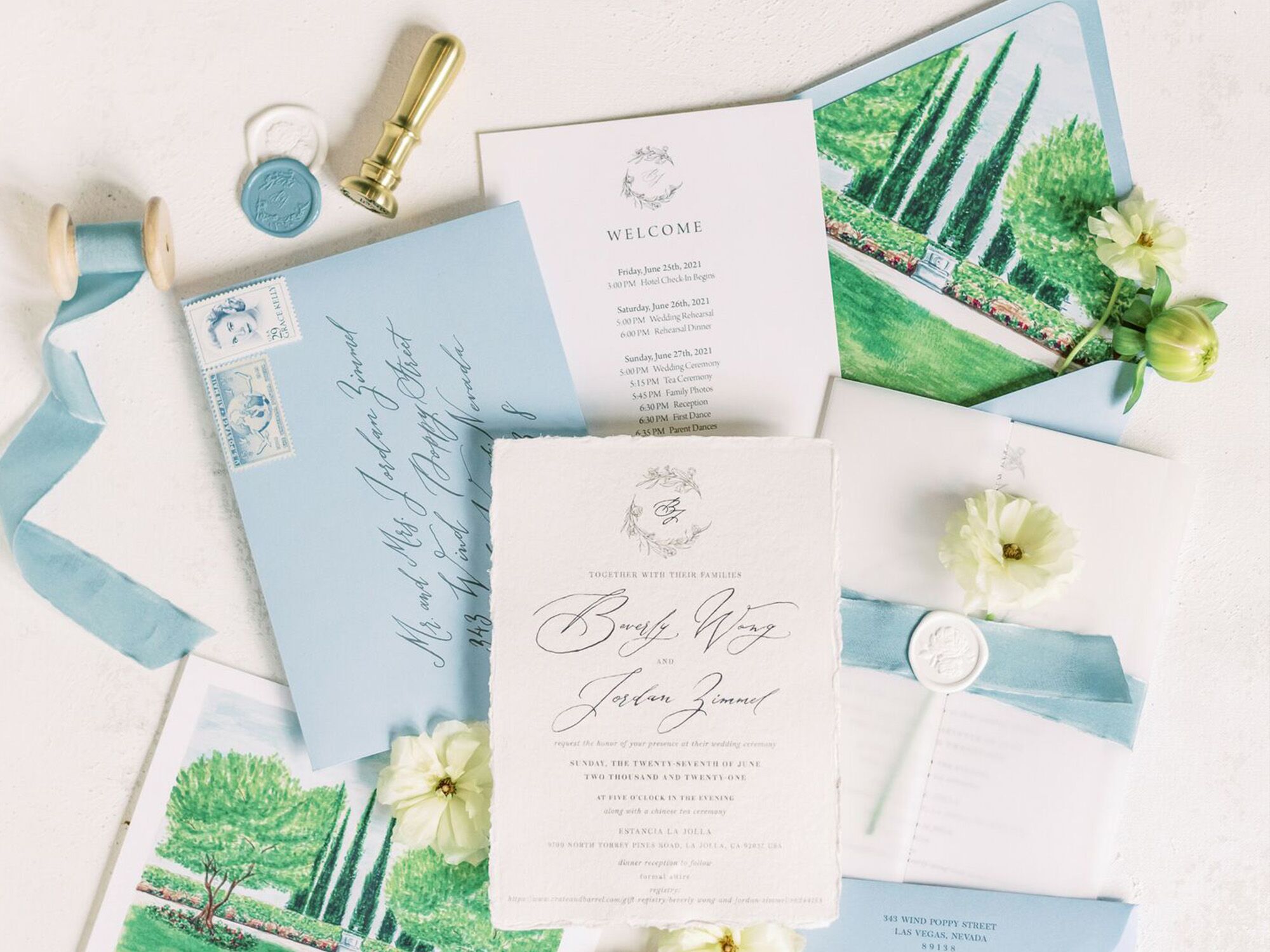
The invites you choose for your wedding aren't just your guests' first look at the style or theme of your wedding day—they're also a crucial logistical element. That's where wedding invitation etiquette comes in. As long as you follow the right etiquette protocol and advice, you'll be golden. Below, we're answering the most pressing questions about etiquette for wedding invitations.
In this article:
- Top Wedding Invite Etiquette Tips
- Timing and Logistics Wedding Invitation Etiquette
- Mailing Wedding Invitation Etiquette
- Formatting Wedding Invitation Etiquette
- Guest-Related Wedding Invitation Etiquette
Top Wedding Invite Etiquette Tips
Here are the basics: A few pieces of specific info are shared on wedding invitations—anything else can be included on your wedding website. And if you create your wedding website on The Knot, you can grab a matching invitation suite from The Knot Invitations to create cohesion across all your wedding correspondence. Find a few more top pieces of etiquette for wedding invitations below.

Photo: Tiana Crispino
Timing and Logistics Wedding Invitation Etiquette
These questions cover the basics on deadlines and due dates.
1. What's the correct wedding invitation timing?
Invitations go out six to eight weeks before the wedding. This timeline of when to send wedding invitations gives guests plenty of leeway to clear their schedules and make travel arrangements if needed. Most couples also send out save-the-date cards so that their guests can hold the day in their calendar before getting into the details.
2. How do I select a due date for RSVPs?
Make your RSVP due date at least two to three weeks before your wedding date. This should allow enough time for you to get a final headcount to the caterer (one week before) and to finalize your seating chart. When should RSVPs be due for your wedding if you're worried about bids getting to invitees on time? You can scooch it to three to six weeks before the wedding. If some guests still haven't responded by your deadline, send them a RSVP reminder on your wedding website.
FEATURED VIDEO FROM THE KNOT
3. Should I put the actual ceremony start time on my wedding invitations?
While putting an earlier time on your wedding invitations than the actual ceremony start time isn't a new idea, you should put the real ceremony time on your invites. By placing a false start time on your wedding invitations, your loved ones could end up waiting much longer than they need to for you and your future spouse to arrive.
4. Do I include start times for every event within the wedding on my invitations?
It's not necessary to include additional start times on your wedding invites (think: the cocktail hour and reception) when it comes to writing the date and time on invitations. If the events are all taking place on the same day at the same location, simply stating "reception to follow" is enough. If your reception is at a different venue, you can include the location beneath the ceremony details or on a separate reception card depending on the space available. For jam-packed wedding weekends, it's a good idea to have separate itinerary cards with the respective date, time and location of each event. These can be sent out with your wedding invitations or included in wedding welcome bags.
5. Should I order more wedding invitations than I have guests?
Yes, it's never a bad idea to have a few spare invites in case one gets lost or damaged, or if you would like to extend invites to a few more guests if you have room after the initial wave of RSVPs come in. This situation is actually pretty common and should be handled with care.Try not to make the new invitee feel like they're on the B-list. It's a good idea to explain the situation delicately, especially if they're getting a last-minute invite.
Mailing Wedding Invitation Etiquette
So much of the etiquette behind wedding invitations surrounds when and how to mail these special pieces of correspondence. Get your questions answered below.
6. What is the proper location for the return address on wedding invitations?
The return address usually goes on the back flap of the envelope. Also, the return address used should be that of the person(s) whom you've designated to receive response cards, be it yourselves or your parents (traditionally, whoever is hosting the wedding handles response cards).
It might be tempting to skip this step, but including a return address when addressing wedding invitations is actually really important. If for any reason an invite doesn't get delivered, you won't end up losing it completely and you can reach out to the guest directly to update them on the issue and ask for another address. That way, you won't risk any hurt feelings when they hear of others receiving their invitations and wonder why they didn't get one.
7. Do you have to include postage stamps on RSVP envelopes?
It's proper wedding invitation etiquette to include the host's address and postage on the envelopes for your response cards. Guests should not be expected to fill out this information or pay for postage themselves. You'll get your guest list finalized a whole lot faster if you don't skip these special stamps for wedding invitations.
8. Can I hand deliver my wedding invitations?
You can hand deliver your invitations if you'd like, though it's best to just pop your wedding invitations in the mail simultaneously, as it ensures they get to guests at relatively the same time. This way, no one wrongly thinks they weren't invited.
9. Do you have to send separate invitations to members of the same family?
Proper addressing wedding invitation etiquette requires separate invitations for adult children. Yep, even if they live in the family home. For kids under 18 years old, you can include them on their parents' invite by listing their names on the inner envelope.
10. What's the proper order to stack cards in a wedding invitation suite in an envelope?
You should order your wedding invitation suite cards from largest in the back to the smallest in the front, with all text facing up. Following this piece of proper etiquette for wedding invitations ensures that the little cards don't get lost or left behind in the envelope.
11. Do you have to mail all of your wedding invitations at the same time?
Yes, try to mail your wedding invitations at the same time so all guests get the good news at once. The only exception would be if you have a B-list of guests—and in this case, you should set the RSVP deadline for the first batch on the early side so the lag between the two waves is as small as possible.
Formatting Wedding Invitation Etiquette
The bits and bobs below dive into wedding invitation verbiage etiquette, wedding invitation envelope addressing etiquette and more.
12. Are digital wedding invitations okay to send?
Digital invitations don't exactly align with traditional wedding invitation etiquette, but they do exist and they are okay to send if you want. For example, if planning an eco-friendly wedding down to the very last detail is important to you and your fiancé, then you should do what aligns with your values. Just make sure to keep guests in mind too. It might make sense to have a few physical invitations for loved ones who are less tech-savvy.
When it comes to RSVPs, many couples are taking a digital-first approach and asking guests to RSVP through their wedding website. Again, it's a good idea to offer a paper RSVP option as well for guests who are less familiar with technology.
13. Whose name should go first on a wedding invitation?
Historically, the bride's name was listed first on traditional wedding invitations, however, in modern weddings today this is not a hard-and-fast rule and couples should feel empowered to order the names as they best see fit. Some couples may choose to order the names alphabetically or in a way that sounds pleasing and rolls off the tongue nicely.
Alternatively, the layout and design of the invitation itself might affect how you format the names. Work with a professional stationer to design an invitation suite that makes your names and your wedding vibe shine. Pro tip: You can find stellar wedding stationery pros on The Knot Vendor Marketplace.
14. Do people still put parents' names on wedding invitations?
Parents should be named on the invite if they're hosting. If a few people are chipping in (for example, the couple and their parents), it's appropriate to write "together with their parents" or "together with their families" on the invites instead to abide by the proper etiquette for wedding invitation etiquette for wording.
15. Do you include the groom's parents on a wedding invitation?
Yes, it is common to include the groom's parents' names on the wedding invitation, especially if the groom's family is contributing financially to the wedding. Traditionally, in weddings with a bride and groom where the bride's parents were paying completely for the wedding, the groom's parents' names may have been left off the invitation. However, it's becoming much less common to leave off the names of the parents of the second partner.
16. Do you include a deceased parent's name on a wedding invitation?
THough not required, you are more than welcome to include the name of a deceased parent on your wedding invitation. You may consider adding ", in spirit" after their name, or refer to them as "the late [name]."
17. Can I put information on the back of my wedding invitations?
It's better to include details that don't fit on your wedding invitation on a separate details card rather than on the back of the invite itself. You don't want guests to miss an important piece of information because they didn't turn over the invitation. It's also possible to overcrowd your invitations with too many details (on the front or back), and that can take away from your stationery's beautiful design. Insert cards are the perfect solution.
Of course, that doesn't mean you can't make the most of the space on your wedding invites. Many couples include a monogram, personalized wedding logo or another unique design element on the back.
FOR YOU

20 Elopement Announcement Cards to Share the News
Let your fam' and friends in on your newlywed status with these pretty paper pieces.

Where to Find Printable Wedding Invitation Templates
Looking to save on stationery? Here are our favorite picks.
Our Guide to Wax Seals on Wedding Invitations
Signed, sealed, delivered—emphasis on the sealed part.
18. Should I write the dress code on my wedding invitations?
Yes, include invitation dress code wording near the bottom of the invite or on a separate details card. "Black tie," "cocktail attire" or "dress casual" are all acceptable templates. (And trust us, your guests will appreciate the heads-up).
If you'd prefer not to explicitly state the dress code, that's okay too. Instead, your invitation design can clue guests in. For example, a traditional invite with letterpress and calligraphy hints at a formal event, while an invite with a playful font and bright colors fits a casual style. Another option is to direct guests to your wedding website, where you can go into detail about the weekend events and dress code in a more informal forum.
19. Can I ask for meal selections on wedding invitations?
You do not include meal selections on the wedding invitation itself, however, you can ask guests to confirm their meal choices on RSVP cards. Additionally, the RSVP is a convenient place to ask guests if they have dietary restrictions that need to be taken into consideration. Alternatively, you can ask about meal selections via digital RSVP on your The Knot wedding website.
20. Where does one put a wedding website URL on a wedding invite?
A wedding website URL doesn't usually get printed on the wedding invitation itself, but you can include it on a separate details card. In fact, there are a few places you can share your wedding website with guests without breaking any etiquette rules. A simple "TaylorandPayton.com" on your save-the-dates is a great way to let guests know from the beginning that you have a wedding website. You can also incorporate a QR code into your invitation design that drives to your wedding website. (BTW, if you set up a wedding website on The Knot, we've got stationery designs to match—how cool is that?)
21. Is it necessary to include a QR code on my wedding invitations?
There's no etiquette rule that says you should or shouldn't include a QR code on your wedding invitations. Though, having a code that guests can scan with their smartphones makes it easy to access your wedding website and easy to get those digital RSVPs in. It's a win-win.
22. Should wedding registry information be included on invitations?
No—including registry info on your wedding invitations or save-the-dates is considered impolite because it can give the impression that you're outright asking guests for gifts. So how do you let your loved ones know about your wedding wish list? Go ahead and put your registry details directly on your wedding website. (Psst, The Knot Registry lets you combine all of your registries in one convenient spot.)
Don't plan on setting up a personal website? It's fine to include registry details on your wedding shower invitations or spread the news by word of mouth. Your parents, wedding party and other close friends will be able to fill guests in without breaking traditional wedding invitation etiquette.
23. What does "reception to follow" mean on an invitation?
The phrase "reception to follow" on a wedding invitation is commonly used to let guests know that the party will extend beyond just the wedding ceremony. (The time listed on the wedding invitation denotes the start of the wedding ceremony.) However, wedding ceremonies are commonly followed by cocktail hour and a reception. You can include more details about the reception on a separate details card in your wedding invite suite.
Guest-Related Wedding Invitation Etiquette
Some of the stickiest situations with proper etiquette for wedding invitations involve guest-facing elements. Learn what to do below.
24. Do you have to give every guest a plus-one?
You definitely don't have to give every single guest a plus-one. If they're not married or in a serious relationship, it's perfectly acceptable to extend a solo invite. Most of your loved ones will understand that without "and guest" or another name on the invitation, they aren't invited with a plus-one. Do note: There are some simple etiquette guidelines for assigning plus-ones that'll make your job a little easier.
While it's nice to invite everyone with a guest, numbers add up quickly (in terms of both headcount and cost). If a guest RSVPs for two, call them and explain you're trying to be diligent about your guest list, and unfortunately, you were not able to invite everyone with a guest. If you realize that nearly everyone will be coupled up, you might want to extend a plus-one invitation to your few single friends and family members.
25. Should all plus-ones be invited by name?
You don't have to invite plus-ones by name, though in an ideal world, all of your guests will be invited by name. Taking the time to find out their names and preferred titles is an extra step that makes each person truly feel like a part of the celebration rather than a tag-along. If you've done some digging and can't confirm their full name and title, it's better to play it safe and use "and guest."
26. How do we make it clear that we're having an adults-only wedding?
If you're having an adults-only wedding, simply list each guest by name (not "and guest" or "family"). This distinction in how you address your wedding invitations should make it clear that the invite is only meant for those mentioned. Keep in mind that it's not considered proper etiquette to directly print this detail on the invitation. If you find that some guests reply with their children's names added, give them a call and explain you're having an adults-only wedding and you hope they can still attend. If there are a lot of kids in your family, you may want to consider hiring or arranging for a babysitter. It's definitely not required, but it's a nice gesture. If you do organize childcare, be sure to include this information on the wedding website.
27. Is it okay to invite people to the ceremony or reception only?
Standard etiquette dictates that everyone who attends the ceremony (or shower or engagement party) should be invited to the wedding reception. By inviting guests to the ceremony and not the reception, it could send the message that you don't want to pay for their plate at your party or you don't care enough to have them there to actually celebrate your newlywed status.
Though, holding a small, intimate ceremony followed by a larger reception is becoming increasingly popular among to-be-weds. Nowadays, it's totally acceptable to keep your ceremony guest list small and invite additional guests to the reception only. Just make sure that your invitation wording is clear so that your loved ones know what to expect.
28. Do you have to invite someone who invited you to their wedding?
Ultimately, you don't have to return the invite, but if they're still a close friend you see or speak with regularly, or their wedding took place recently, it's a nice gesture to make room for them on your guest list. If their wedding was a long time ago and the nature of your relationship has since changed, it's okay not to invite them. Just be mindful of how they hear the news—if you're still friends, politely let them know they aren't invited to the wedding yourself. When deciding on the guest list, it's normal to be on the fence about some people—particularly if you were invited to their wedding but you no longer feel as close.
29. If you invited a guest and their S.O. by name, but they recently broke up, can the guest bring someone else instead?
Long story short: If you worded the invitation by having their partner's name on the envelope (rather than "and guest"), you have every right to say no to a new plus-one. As a rule, invitations are nontransferable when people are invited by name. This can help avoid the situation of a guest bringing someone you don't know or aren't particularly friendly with. Or perhaps there's someone else who didn't make the original guest list that you'd like to extend an invite to instead.
As for the guest who will be attending solo, if you invited all of your single friends sans dates, let them know they won't be the only one (in case that's their worry). On the other hand, if the invitation was addressed with "and guest" rather than specifying their plus-one by name, they're generally free to bring whomever they want.
30. Is uninviting someone from the wedding ever acceptable?
Uninviting a guest from your wedding is not something you should take lightly, and generally isn't advised unless it's absolutely necessary. In any case, it's not good wedding invite etiquette to uninvite guests, whether it's due to a change in venue, problems with your budget or a disagreement. If you've fallen out with a particular guest, revoking their invitation is likely to make the situation worse (and you definitely don't need that stress ahead of your wedding day). It's also going to make your friendship more difficult to salvage, regardless of what caused the disagreement in the first place. Discuss the matter with your fiancé, and if you both agree that uninviting the guest is the only reasonable course of action, reach out to the guest directly to explain. Preferably, this should be a face-to-face conversation.


