


"I like it when people say, 'How did it last so long?' I say, 'It's still going."
Updated Mar 04, 2025Here's the Average Wedding Guest Cost and How to Budget for It
Keep your balance in check this wedding season.

Photo: Coryn Kiefer Photography

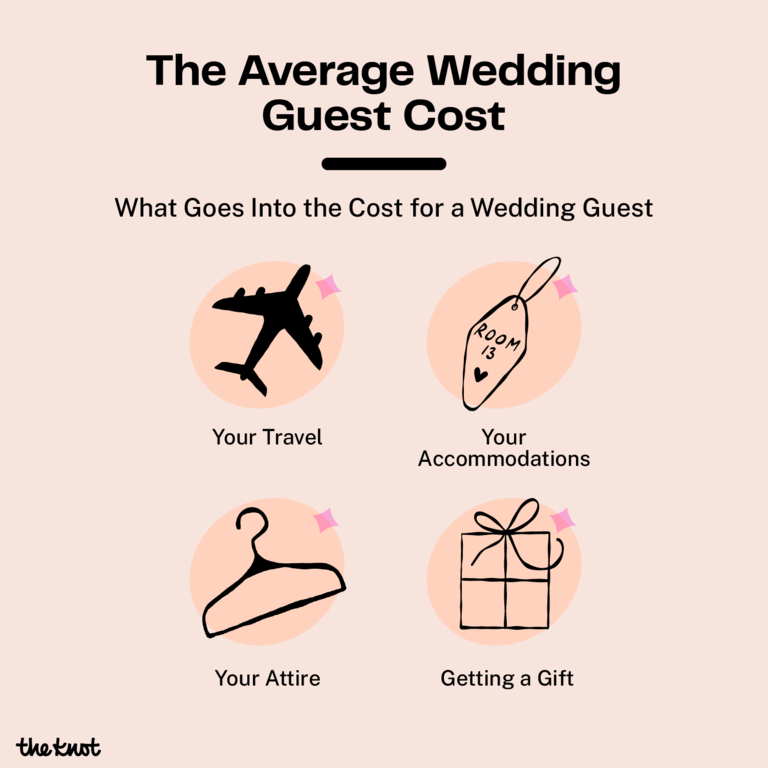
Anyone who has attended a wedding recently knows the price of being a guest adds up quickly. Between booking travel and lodging, buying new attire and finding a wedding gift, how do you budget for the exciting invitation?
With the help of The Knot Guest Study, we break down the average cost per wedding guest so you know what to expect when a loved one gets engaged. We've also tapped finance and wedding planning experts for their professional advice for guests, from money-saving tips to protecting your financial well-being. They also share what to do if you can't afford to attend a wedding.
At a Glance
- The average cost of attending a wedding is $610, according to The Knot Guest Study, which surveyed 1,000 US adults in 2024.
- The cost of attending a wedding is driven primarily by travel and lodging costs as well as finding appropriate attire and giving a wedding gift.
In this article:
What Is the Average Wedding Guest Cost?
The average cost of attending a wedding is $610, according to The Knot Guest Study, which surveyed 1,000 US adults in 2024. This $30 increase from the previous year is primarily driven by rising accommodation costs, with more guests opting for two-night stays rather than one. Additionally, travel expenses have climbed for both drivers and flyers.
Despite rising prices, guest sentiment remains overwhelmingly positive; 67% of guests report high levels of enjoyment at weddings they've attended, rating their experience an 8, 9 or 10 on a 10-point scale. This could be driven by couples' commitment to enhancing the guest experience. The Knot Real Weddings Study found that 69% of couples said ensuring guests are well taken care of and have a good time is one of the most important elements of planning.
FEATURED VIDEO FROM THE KNOT
Design & Illustration by Tiana Crispino for The Knot
Factors That Impact Wedding Guest Costs
The average wedding guest cost can fluctuate significantly based on an event's location, formality and an invitee's relationship to the couple. Here are some things to keep in mind as you set a budget.
Travel and Lodging Costs
A wedding's location has the greatest impact on the cost of attending a wedding. For guests attending a wedding in their own hometown—requiring no travel or lodging—the average spend is $270. This remains a common scenario, as 58% of couples marry near their current residence and 25% choose to wed in their hometowns.
However, costs rise significantly when travel is involved. While only 17% of couples categorize their event as a destination wedding, the vast majority of that group—83%—confirm that their guests must travel or stay overnight to attend. For these attendees, the price of invitation is steeper: guests who drive spend an average of $840, while those who fly report a staggering $1,680 per wedding.
When it came to finding accommodations, 79% of guests said price is the biggest decision factor. Of the 65% of respondents who paid for accommodations, 54% stayed in a hotel, while 19% booked a vacation rental (like Airbnb or VRBO) and 9% chose to stay in a traditional bed-and-breakfast or inn.
Attire Costs
Beyond travel, finding the perfect attire has emerged as a top factor that influences cost for wedding guests. According to The Knot's research, economic pressures have intensified this struggle: 46% of respondents reported that the current economy has forced them to scale back their wardrobe spend—a 4% increase over 2023. While a semi-formal aesthetic is most common (favored by 60% of couples), 19% of weddings require formal or black-tie attire, leaving guests to balance high-fashion expectations with more conservative budgets.
Gift Costs
The average price of a wedding gift is $150. However, this average changes depending on the person's relationship with the couple. In 2024, close friends, family and wedding party members typically spent $160 on a wedding gift while a guest's date or plus-one spent $120 and a casual friend spent $140. Only 6% of guests reported not giving a wedding gift.
How to Prioritize Financial Wellness During Wedding Season
You should embrace the opportunity to celebrate the lovebirds in your life, but it's also important to protect your well-being as a wedding guest. This includes your financial goals and responsibilities. It's okay to splurge as long as you can comfortably afford to. If you're able to divert the cost of usual discretionary expenses like dining out to cover the cost of a wedding gift or your cab fare to and from the venue, even better.
Making a few swaps here and there can help you set a healthy budget that'll allow you to enjoy the wedding celebrations without putting other financial goals—such as saving for a home or paying off debt—on hold. Follow these tips for a stress-free wedding season.
Take stock of your finances.
Checking in with your savings goals, loan repayments and other financial commitments is essential before setting a budget to attend a wedding (or multiple weddings). Calculate how much money you can put toward wedding guest expenses after regular bills, savings and loan contributions. From there, you can determine if any adjustments need to be made.
Start saving early.
Prepare for your wedding guest expenses well in advance of the big day. "Use the first save-the-date as your cue to start saving money," advises Lauren Bringle, accredited financial counselor at Self Financial. Since save-the-dates go out six to eight months before the nuptials (and even earlier for destination weddings), you'll have plenty of time to start putting money aside. Just $10 a week for six months will give you roughly $240.
Take advantage of credit card points.
The average wedding cost per guest doesn't have to be a scary number. Credit card points are an often-underutilized resource. Bringle suggests either saving up points to cover wedding travel expenses or using them strategically so they serve you after the celebrations. They can go toward cashback for necessities or rewards points that help you take a lower-cost vacation later.
Keep on top of your budget.
If you're wondering how to lower the cost of attending a wedding, you have to stick to your budget. "Track your spending and make adjustments as needed," says Allison Davis, founder of wedding planning and even production company Davis Row. Online services and apps like Mint, Monarch and YNAB can help you organize and track your finances. Don't despair if the original budget you set isn't working out: sit down, relax and reevaluate.
FOR YOU
The Knot Wedding Planning App Every Couple Should Have
Get 24/7 help organizing your dream celebration.

Here's What to Do If a Wedding Vendor Cancels
The Knot has your back here, big time.

The Must-Haves for Your Wedding Day Emergency Kit
No stain, rip or smudge is a match for these little day-of heroes.
Make the most of your trip.
If you're spending money on flights and taking time off work to attend the couple's wedding, why not turn it into a vacation? Stay a few days after the nuptials to explore the area and unwind. Not only will you get to watch your loved ones tie the knot, you'll also score an awesome vacay by maximizing your travel investment. It's a win-win.
How to Attend a Wedding on a Budget
For many, budgeting to attend a wedding isn't as straightforward as putting some extra cash aside for a few months. Sometimes, it's necessary to make compromises or be more picky about your hard-earned dollars. Read up on these clever tips to save money on your wedding guest costs (without too many sacrifices).
Choose your attire wisely.
You don't have to buy a new outfit just because you got a wedding invitation. The easiest way to save money on your attire is by wearing something you already own, but that's not the only way. Davis suggests renting a wedding guest outfit instead of buying a new one. Or, as Bringle advises, you could do a clothing swap with friends to mix things up.
Don't leave things to the last minute.
"Waiting until right before the wedding for anything (like buying flights or gifts.) limits your options and could result in you paying more out of necessity," Bringle says. Instead, search for early deals on travel and accommodations. Look out for upcoming sales so you can score a great bargain.
Use the couple's registry to your advantage.
Eighty-two percent of couples set up a registry as part of their wedding planning, and it is recommended that they offer gift ideas for every budget. By using the couple's registry, you're guaranteed to find something they really want that is within your means. Nowadays, many soonlyweds include experience and cash funds on their registries, where you can decide how much you want to give. "Even if it's just enough to cover a couple rounds of drinks or an excursion during the honeymoon, you know your gift will contribute to an experience they'll never forget," Bringle tells us. (Psst: Here's how to find a couple's wedding website, which most likely will have all their wedding registry information.)
Join forces with fellow wedding guests.
"When it comes to travel and accommodations, try to see what costs you can split with friends who are also attending," Davis suggests. "Maybe you synchronize your flights to share a ride from the airport or road trip to the destination together."
Contributing to a group gift—a strategy used by 25% of guests—is another excellent way to spoil the newlyweds with a big-ticket registry item without taking on the hefty price tag alone.
Plan for pre- and postwedding events.
In addition to a ceremony and reception, The Knot Real Weddings Study found that 28% of respondents had an engagement party; 65% had a shower; 67% had a bachelor party; 75% had a bachelorette party. So, if you're close with one or both of the to-be-weds, you'll likely receive invitations to these prewedding events. You should factor these extra costs in when you receive your wedding invite. "Before responding to the invitation to attend or especially to participate as a wedding party member, consider if you can afford to invest the energy, time and money that's required," Nadia S. Anderson, certified public accountant and founder of Virginia Grace Events.
What to Do If You Can't Afford to Attend a Wedding
If your day-to-day financial responsibilities don't leave lots of wiggle room, you might wonder whether you can afford the average cost of attending a wedding. Before you decline the invitation, remember that the couple didn't invite you with the expectation of a gift or a trendy new outfit. They asked for your presence to share their special day with you.
If the wedding is local, see if you can shift some things around to attend. Prioritize the essentials, such as your travel to and from the venue. "I suggest that wedding guests focus on thoughtful ways to show and share love with the couple," Anderson says. If that means only showing up to the ceremony and reception, that's okay. Additionally, wedding gift etiquette permits you to send a present for up to a year (though within three months is most recommended) after the wedding, so you can always mail the newlyweds your congratulations later.
For out-of-town weddings, declining the invite might be what's best for you and your financial situation. Sending your regrets should be handled lightly. "If you decide you can't afford to attend a wedding, send well wishes and warm thoughts for a lovely celebration as soon as you know that you can't attend," Anderson advises. You don't need to detail exactly why; knowing you can't afford to be there may add to the couple's stress. "I suggest sending a gift and encouraging note before the wedding date and plan to connect in person to celebrate the couple after the wedding," Anderson adds.
How The Knot Calculated the Average Cost for Wedding Guests
The Knot Real Weddings Study captured responses from 10,474 US couples married between January 1 and December 31, 2025; respondents were recruited via email invitation from The Knot and/or WeddingWire membership throughout the year 2025. Respondents represent couples from all over the country with various ethnicities, income levels, race, age (18+), sexual orientation and gender identity. To provide the most comprehensive view of 2025 trends, this report also includes wedding statistics from ad hoc studies conducted throughout the year. In a typical year, The Knot Worldwide conducts research with more than 100,000 couples, guests and wedding professionals globally.
The Knot Guest Study captured responses from 1,000 US adults, ages 18-54, in October 2024. Respondents were recruited via a third-party research company and required to have attended at least one wedding in person in 2024.
Additional reporting by Emily Rumsey, Naoimh O'Hare and Shyla Watson


