




"I like it when people say, 'How did it last so long?' I say, 'It's still going."
Updated Mar 04, 2025Who Pays for the Wedding? Here's How Costs Are Traditionally Divided
Plus, get helpful tips from the editors to modernize outdated wedding budget "rules."

Photo: Stocksy

No matter where you are in the wedding planning journey, you've probably contemplated one of the most common questions: Who pays for the wedding, traditionally? If you're dreading the thought of divvying up your wedding budget, you certainly aren't alone. The topic of money can be challenging to navigate in any relationship or family, especially when it comes to deciding who pays for what in a wedding and aligning on your wedding budget breakdown.
If you've done any amount of research, you might be aware of traditional rules that say certain people have to pay for certain wedding costs. But we're here to say that the concept of who typically pays for the wedding is more or less outdated because those traditional guidelines are based on old gender roles and stereotypes. Today, couples are completely rewriting the rules around who normally pays for what in a wedding. And since no two situations are exactly alike, there's no right or wrong way to do things.
Here, we explain who traditionally pays for a wedding to help you figure out common ways to split wedding costs among yourselves and loved ones. And if you find yourself still confused even after discovering who is technically supposed to pay for the wedding, tap an expert wedding planner from The Knot Vendor Marketplace for more insights. (Psst: You can also find wedding pros, tips and free planning resources with The Knot app).
FEATURED VIDEO FROM THE KNOT
Who pays for what in a wedding? The traditional breakdown:
Consult this scannable overview of who pays for the wedding traditionally, then click each category to learn more.
-
Ceremony: Bride/her family pays for ceremony venue and vendors; Groom/his family pays for marriage license and officiant fee
-
Wedding Attire: Bride/her family pays for wedding dress; Groom/his family covers wedding attire; Wedding party covers their outfits
-
Flowers and Decor: Bride/her family family pays for ceremony and reception floral arrangements, bouquets and corsages for bridesmaids and flower girls; Groom/his family pays for bride's bouquet, boutonnieres for men and corsages for mothers and grandmothers
-
Honeymoon: Groom/his family
- Photography: Bride/her family family
-
Prewedding Parties: One of the to-be-wed's family plans and hosts the engagement party; Groom's family typically plans and hosts the rehearsal dinner; The maid of honor and bridesmaids usually host the bridal shower and bachelorette party; The best man and groomsmen often host the bachelor party
-
Reception: Bride/her family pays for all professional services; Groom/his family pays for the DJ/band and liquor
-
Wedding Rings: Bride pays for the groom's ring; Groom pays for the bride's ring
-
Stationery: Bride/her family
-
Transportation: Bride/her family
- Hair and Makeup: Bride/her family pays for hair and makeup if professional glam is required
- Gifts: Couple splits costs
- Extra Wedding Weekend Events: Couple pays for extra wedding weekend activities
But who pays for a wedding today? Click here for a modern take on the traditional "rules"
Who Traditionally Pays for the Wedding
Figuring out how to divvy up your wedding expenses is easier said than done, especially when multiple families and parties are involved. If you're planning to split costs based on major items, our printable chart below is a sample breakdown of who usually pays for the wedding when you're dividing the costs among yourselves, parents and other loved ones. It's important to note that these tips are purely based on heteronormative tradition, and the rules below of who pays for what certainly aren't set in stone, so you can use them as a starting point and customize as needed.
To begin, use The Knot Budget Advisor to help set priorities and estimate costs based on real couples in your region. Read on for tips on wedding protocol for who pays for what and the best approach for your unique circumstances.
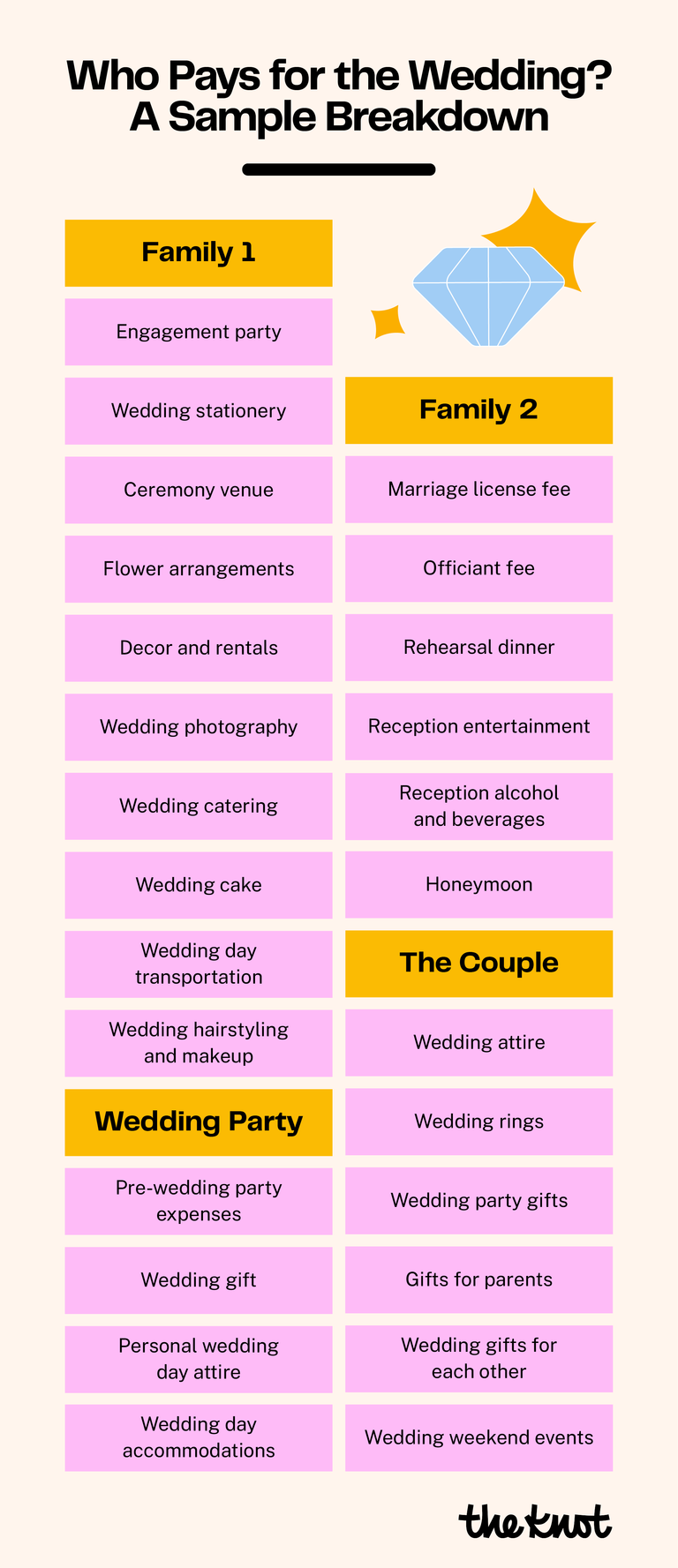
Design by Natalie Romine for The Knot
According to The Knot Real Weddings Study, the average age of marriage is 32 years. Because people are getting married later in life, some couples are more financially equipped to take on more (or all) of the wedding costs themselves. Plus, given the importance now placed on the overall experience, more couples are willing to splurge on the upgrades and extras they want to make their dream wedding a reality. Of course, that's not to say to-be-weds don't receive any financial help from family members.
Here's what our study found about who pays for the wedding in America:
- 52% of the budget was paid for by the couple's parents (Respondents reported that 38% was covered by their family, while 14% was covered by their partner's family)
- 47% of the budget was paid for by the couple
So, how do you decide which rules to follow when it comes to who pays for what in a wedding? The choice is ultimately yours. "Some couples definitely still subscribe to these traditions, but it's hardly a 'given' these days as we are seeing many more couples opt for less traditional splits," says Landis Bejar, founder of NYC-based boutique wedding therapy practice AisleTalk. "In some cases, that looks like both partners' families contributing more equally, the couple making a substantial contribution or financing the wedding themselves, or any combination."
Ultimately, deciding who should pay for the wedding is up to you, your partner and your families. For couples who identify as a bride and a groom, the costs for each family are outlined below—but the bottom line is that the list of who usually pays for the wedding is open to your interpretation (and modifications are encouraged).
Read more traditional wedding money etiquette: What the bride's family pays for & What the grooms's family pays for
Ceremony
- The bride and her family generally cover the cost for the church, synagogue or house of worship, along with the sexton, organist and other vendors specific to the ceremony.
- Traditionally, the groom and his family pay for the marriage license cost and officiant fee.
Wedding Attire
- Who pays for the wedding dress? This ultimately falls to the bride and her family. They're also expected to cover the cost of the veil, accessories and the rest of the wedding wardrobe, including outfits for the shower, bachelorette party, rehearsal dinner and honeymoon.
-
The groom's family pays for the groom's outfit and accessories such as shoes, socks, a watch and cufflinks.
The wedding party is generally expected to pay for their outfits: the bridesmaids pay for their dresses, while groomsmen pay for their suits.
Flowers and Decorations
- The bride and family traditionally pay for wedding floral arrangements for the ceremony (including a chuppah if it's a Jewish wedding ceremony) and reception, plus bouquets and corsages for bridesmaids and flower girls.
- According to traditional wedding etiquette on who pays for what, the groom and his family cover the cost for the bride's bouquet, boutonnieres for men and corsages for mothers and grandmothers.
Honeymoon
Generally, the groom and his family pay for the complete honeymoon.
Photography
The bride and her family traditionally pay for all wedding photos and videos.
Prewedding Parties
- One of the to-be-wed's family plans and hosts the engagement party; if there's more than one, the bride's family traditionally hosts the first one.
- The groom's family typically plans and hosts the rehearsal dinner.
- The maid of honor and bridesmaids usually host the bridal shower and bachelorette party.
- The best man and groomsmen often host the bachelor party.
- Friends may throw additional engagement parties or showers.
Reception
- The bride and her family pay for all professional services, including food, flower arrangements and decorations.
- The groom's family pays for the DJ or band and liquor.
Wedding Rings
- The bride and/or her family pay for the groom's ring.
- The groom and/or his family pay for both of the bride's rings.
Stationery
The bride and her family pay for invitations, announcements and wedding programs, per traditional wedding etiquette.
Transportation
The bride and her family pay for transportation of the wedding party to and from the ceremony and reception.
Hairstyling and Makeup
-
If the couple is requiring their wedding party to have professional hair and makeup done for the wedding day, the beauty cost should be covered by the bride, her family or the couple.
Gifts
- While not necessary, some couples choose to purchase gifts for each other to open on the morning of the wedding.
- The couple pays for gifts given to parents and wedding party members on the wedding day.
Extra Wedding Weekend Events
One cost to be aware of is the addition of wedding weekend events. Some couples may want to extend the celebrations, especially if you're swapping vows in a destination that requires travel for most guests. If this might be of importance to you, it's critical to bake in the extra wedding costs early in your planning process.
- Additional wedding weekend excursions, such as group activities, are covered by the couple.
- Some couples may want to host a wedding welcome party, especially if they're hosting a destination wedding requiring guests to travel. If this is in addition to the rehearsal dinner, the couple pays for the party. If it's in lieu of the rehearsal dinner, the groom's parents may pay.
- Typically, the newlyweds host and pay for the postwedding brunch. Parents can step in if they want to.
Who Pays for the Wedding in Modern Times
Despite the traditional breakdown of wedding costs, it's up to you and your loved ones to decide how best to choose who pays for what in the wedding budget. "In some ways, 'old traditions' made it easier on couples, because they provide a script to follow with no confusion and perhaps fewer difficult or awkward conversations," Bejar says. "But when we buck tradition, we get to make our own rules."
While it's empowering to modernize wedding payment traditions, it can also feel confusing to set guidelines without a clear breakdown of who pays for what for a wedding. Her advice? It's all about open and honest communication with financial contributors. "For better or worse, you have to discuss the breakdown of who pays for the wedding with your family and come up with a plan."
Below, find six ways to take a more modern approach when deciding who is supposed to pay for the wedding. Click on each tip to learn more:
- Discuss your priorities first.
- Be realistic about what you can afford.
- Ask family to contribute if you feel comfortable.
- Confirm expectations early.
- Agree on who can have input for wedding decisions.
- Communicate honestly and transparently.
1. Discuss your priorities first.
You might think that setting a budget is the very first wedding planning step. But before you can lock in any numbers, it's important to have conversations about what's most important to the wedding. Do you want the majority of your budget to go toward an all-inclusive venue? Would you rather splurge on a live band? Aligning your wedding priorities is key, as this will dictate how you decide who pays for the wedding ceremony and reception, as well as where the majority of your budget needs to go and where you can afford to scale back.
2. Be realistic about what you can afford.
During the discussion about your priorities and who is supposed to pay for the wedding, it's crucial to be realistic about what you can afford. While you might dream of having a venue covered in lavish floral arrangements, for example, that exact vision might not fit into your budget. The average cost of a wedding is currently $34,200, which can be used as a baseline to guide your budget conversations.
Also consider wedding money-saving techniques to use while working on your budget. While finalizing the number, add a buffer to your budget to account for unexpected overages and last-minute additions, thus saving you from overspending. As awkward as it can feel to talk about money, being realistic from the start of your wedding planning journey is the best way to stay on top of your budget and avoid overspending (or going into debt) for the big day.
3. Ask family to contribute if you feel comfortable.
Given that wedding payment traditions indicate family members usually help cover costs for the wedding, consider asking your parents or future in-laws if they can financially contribute. When it comes to tackling this conversation, Bejar recommends doing it sooner rather than later. "Have the conversation as early as possible to manage expectations and establish clear and normal conversation around finances," she suggests. "It can be awkward depending on your family's relationship to money, but it's better to know what you're dealing with early, rather than when you've started to pay for things or get emotionally invested in the process."
Another tip? Go into the conversation with the intention of asking if they can contribute, rather than expecting it right off the bat. Instead of assuming your family will follow the traditional wedding budget breakdown, try asking if they'd like to cover specific costs, or if they're willing to contribute a lump sum to be used at your discretion. "When you say, 'Let's talk about budget!' follow up with respectful questions like, 'Are you able to help us with the cost of the wedding?' or 'Did you have a budget in mind or specific elements you would like to contribute towards?' and 'How did you envision the cost breakdown?'" Bejar recommends. "This approach allows parents to want to contribute and not feel like an ATM."
4. Confirm expectations early.
Leave this initial conversation with a clear understanding of expectations, knowing exactly what your family will contribute, when they will share the money, what their preferred form of payment is, and how they would like their funds to be used, if applicable. "Confirm that everyone knows what was discussed, and create a chart or a wedding planning spreadsheet to organize things," Bejar says.
5. Agree on who can have input for wedding decisions.
You might be familiar with the phrase, "If you pay, you have a say." This long-debated wedding rule is particularly relevant when it comes to setting a budget and aligning on who will pay for the wedding. Some may think they deserve a say in wedding decisions if they're contributing money, while others disagree. Ultimately, this is another conversation that Bejar urges couples to have with contributors early on. "Families differ on their perspectives on what a wedding means," she says. "For some, it's a family affair. For others, it's all about what the couple wants. Most American couples are socialized to view it as the latter and can encounter some distress when they start planning and realize there are a lot more opinions and stakeholders in the process than expected."
6. Communicate honestly and transparently.
Determining who traditionally pays for the wedding may seem challenging at first, but it doesn't have to be. Approach these conversations with kindness and transparency, and remember that your family members might not be aware of what it actually costs to host a wedding today. Keeping the conversation respectful is crucial for making progress. "The wedding industry changes a great deal year over year, so if this is a parent's first wedding since planning their own, they might be very shocked about what it means to volunteer to cover catering, for example," Bejar explains. "Things also vary a great deal depending on the location, venue, and size and scope of the wedding."
The bottom line is that you and your S.O. should feel empowered to approach your wedding budget planner in the way that makes the most sense for you. Whether you follow tradition or completely toss the rules about who typically pays for the wedding, know that communication and honesty is key for success.


