


Spice things up with these steamy flicks.
Updated Oct 14, 2024What to Know About Engagement Ring Prongs According to Jewelers
When set with the right cut, prongs can elevate your diamond.

Photo: lutherhill | Getty Images

Diamonds might be the most popular aspect of an engagement ring, but they certainly aren't the only factor to consider when shopping. Engagement ring prongs are one of the small details to keep in mind when looking for your perfect ring. Prongs are that tiny claw-like contraption that props your center stone up, and while you won't find them on every ring out there, they are definitely a popular feature. Before you go engagement ring shopping, you should know more about different prong settings. Keep reading to see what professional jewelers can teach you about engagement ring prong styles.
In this article:
- What Are Engagement Ring Prongs?
- How Many Prongs Should an Engagement Ring Have?
- The Types of Engagement Ring Prongs
What Are Engagement Ring Prongs?
Engagement ring prongs are small metal claws that hold your diamond or center stone in place and raise the setting. If a ring has prongs, the stone doesn't lie flat on the band or your finger—instead, it's propped up. If you plan to design your engagement ring, you may need to decide whether you want prongs or not.
Prongs are a way to keep your center stone secure. "By anchoring the stone while leaving most of its surface exposed, they allow light in and, in turn, reflect the gem's brilliance," explains Sally Rong, founder of Rellery. "Alternatives exist like a bezel setting that encases the stone in a continuous band of metal, but for a classic, high-sparkle presentation, prongs remain the industry standard."
FEATURED VIDEO FROM THE KNOT
One of the biggest benefits of engagement ring prongs is that they allow a lot of light to reflect off the stone, making it appear larger and more sparkly. They're also easier to clean, since you have access to most of the stone, and can be easier to resize or repair if you have a damaged engagement ring.
However, one thing to keep in mind is that prongs can get in the way. "Prongs can snag on clothing or hair, especially if they're not well-maintained or start to loosen over time," notes Olivia Landau, jeweler and CEO and founder of The Clear Cut. "You'll want to have your prongs checked periodically to make sure your stone is secure."
How Many Prongs Should an Engagement Ring Have?
Engagement rings can have a number of different prongs. "The number of prongs your engagement ring should have really depends on your diamond shape, size and your lifestyle," Landau explains. Your engagement ring setting ultimately depends on how many prongs, if any, you have.
Having fewer prongs (like three or four) can make your ring easier to clean and make your diamond appear larger. However, Rong notes that it can also provide more exposure to the stone. "If you live a very active lifestyle or work a lot with your hands doing manual labor, this may not be the best choice for you," she warns.
More prongs (like six or eight) can offer your stone a little more protection and security. That said, it also creates more crevices for dirt to gather and get stuck. And Rong says that too many prongs for a smaller diamond may overwhelm the stone. It's most common to find four-prong settings and six-prong settings, but these aren't your only options.
Three-Prong Setting
As Rong puts it, three-prong settings are "made to let fancy cuts steal the spotlight." You're most likely going to see this setting with trillion- or pear-shaped stones, because they allow the most light exposure to maximize brilliance. A three-prong engagement ring offers a cleaner look, since there's less metal, but it is also the least secure option. "I would not recommend three-prongs for a larger stone as you're compromising the stability of your diamond," Rong says. "You also need to be careful, as your diamond is more exposed."
Four-Prong Setting
It's hard to go wrong with a four-prong engagement ring. Rong calls it "sleek, modern and a go-to classic," while Landau describes it as timeless and says it's suitable for most diamond shapes. "It maximizes light exposure and showcases the diamond's shape," Landau says. Rong likes four-prong settings for a princess-cut stone the most, since it provides balance to make the diamond look more square. She also recommends them for smaller stones since they expose more of the diamond, making it appear larger.
Six-Prong Setting
A six-prong setting is another very popular choice, especially for larger diamonds, since the added metal holds bigger stones more securely. "It's perfect for oval or round diamonds, because it hugs the shape and keeps that smooth circle vibe," Rong says. Just keep in mind that this setting can be a bit more pricey and can also make it harder to clean your ring.
Eight-Prong Setting
An eight-prong engagement ring is not one you're going to find very often. Both Rong and Landau note that this is a more popular choice for vintage or heirloom rings. This setting provides the most protection, so it's really best for larger stones—think over three carats—or it can overwhelm the stone. "It holds the stone very securely, but covers more of the diamond, which slightly diminishes its sparkle," Landau says. "It's ideal for vintage-inspired rings, heirloom-style designs, or anyone who prioritizes structure and durability over brilliance."
The Types of Engagement Ring Prongs
There are many different types of engagement ring prongs to consider, and choosing one depends on your style and the cut and size of your diamond. "Some prong types are more minimal and some are more noticeable," Rong says. "Some are also better suited for larger stones."
Claw Prongs

Photo: Science Photo Library | GettyImages
Claw prongs are the most common prong style out there. They are sleek, elegant, and have a pointed tip that makes them resemble small claws—hence the name.
Pros of Claw Prongs: Claw prong engagement rings are versatile thanks to their minimalist design. "This style blends seamlessly with any diamond and accentuates its shape," Landau says. They offer less metal coverage, allowing your stone to really shine through, and Rong notes that they are especially great for enhancing sleek cut stones.
FOR YOU

How to Measure Your Ring Size at Home
Because when it comes to wedding jewelry, size matters.

Where to Find Your Dream Engagement Ring in Houston
When it comes to securing the bling, H-town does not disappoint.
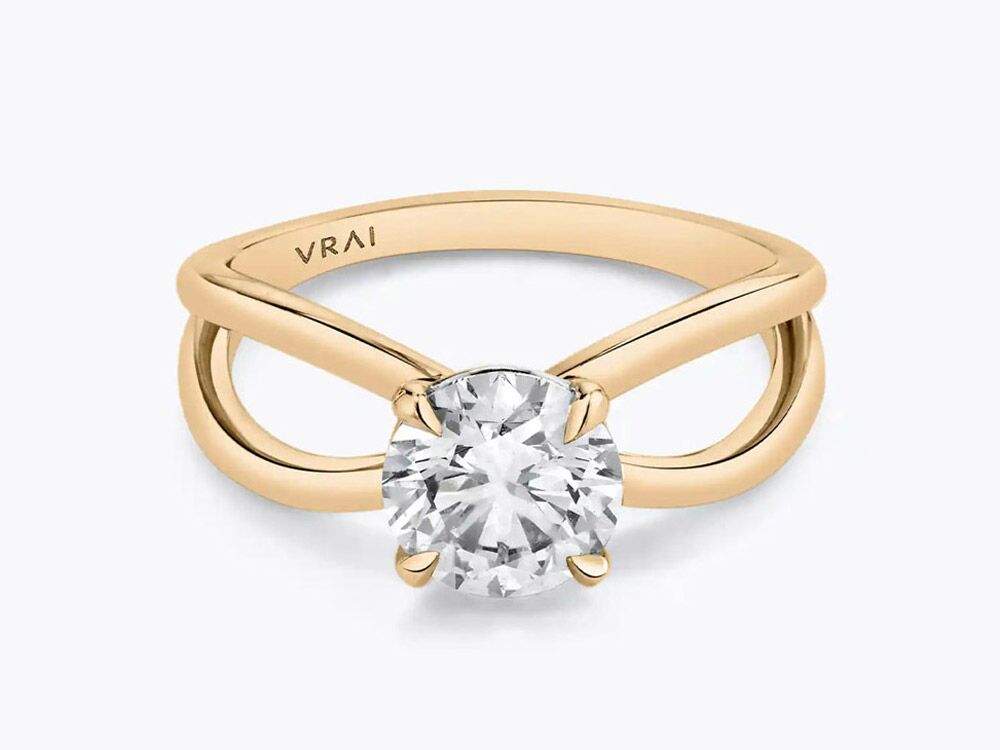
22 Swoon-Worthy Split Shank Engagement Rings
Channel A-listers like Beyoncé with this unique engagement ring setting.
Cons of Claw Prongs: Because of their pointed tip, claw prongs can easily snag on clothing, which is annoying and can eventually cause them to loosen and compromise the security of your ring. "You should periodically get claw prongs checked to ensure they're still securing your stone properly," Rong says.
Best Diamond Shape for Claw Prongs: Round, princess, marquise, oval, and pear-cut diamonds
Petite Claw Prongs

Photo: Amana Images Inc | GettyImages
Just like regular claw prongs, the petite claw prongs have a pointed tip and a sleek appearance. However, as the name suggests, they are even smaller and more minimal than standard claw prongs.
Pros of Petite Claw Prongs: Petite claw prongs are subtle and versatile and work with almost any diamond shape. Their small size covers less of the diamond or center stone and really allows it to shine.
Cons of Petite Claw Prongs: That very pointed tip can definitely snag on your clothing and, like regular claw prongs, should be checked over time to ensure they're still secure.
Best Diamond Shape for Petite Claw Prongs: Round, princess, marquise, oval and pear-cut diamonds
Rounded Prongs

Photo: Glasshouse Images | GettyImages
Another popular option, rounded prongs look very similar to claw prongs. The biggest difference is that they have a rounded tip rather than a pointed one. "The smooth, dome-like tips give rounded prongs a soft, classic appearance," Landau says.
Pros of Rounded Prongs: Round prongs on an engagement ring are very secure, according to Landau, and very versatile—they work with almost any cut. Their rounded edges ensure that they're snag-free as well.
Cons of Rounded Prongs: While their rounded tips make them more secure, they are also less subtle. "Some find round prongs to be a bit bulky or feel that they distract from their diamond," Rong says.
Best Diamond Shape for Rounded Prongs: Round or oval-cut diamond
V Prongs

Photo: Nerida McMurray Photography | GettyImages
V prongs are meant to secure the corners of diamonds with sharper, more pointed cuts. They are slightly wider than other prongs and sometimes resemble the letter "V."
Pros of V Prongs: "V prongs cradle the sharp edges of diamonds and are specifically designed to protect pointed corners," Landau says. They help keep certain cuts a lot more secure and can prevent chipping on parts of a stone that are most susceptible to it.
Cons of V Prongs: Because of their wider shape and slightly bigger size, V prongs can sometimes be distracting and overwhelming, Rong notes. This is especially true if they are on the wrong cut.
Best Diamond Shape for V Prongs: Princess, pear, heart and marquise-cut diamonds
Double Prongs

Photo: Chris Collins | GettyImages
Double prongs can have either a rounded or pointed tip. As the name suggests, they feature two sets of slimmer prongs right next to each other at each point.
Pros of Double Prongs: Double prongs are very secure, making them ideal for larger stones and certain cuts. They also offer a unique, vintage-inspired look that many to-be-weds may be searching for.
Cons of Double Prongs: Because there is more metal with double prong engagement rings, they require more maintenance. Rong says they can also be tricky to repair or replace if something happens to one side but not the other.
Best Diamond Shape for Double Prongs: Emerald or Asscher-cut diamonds
Tab Prongs

Photo: Jeffrey Coolidge | GettyImages
Tab prongs have a distinctive square shape that makes them more unique and also a bit more bulky. They have a vintage, art-deco appeal, according to Landau.
Pros of Tab Prongs: Tab prongs are very secure. When it comes to diamonds that have a geometric shape, they can really accentuate them. And since the tabs are flat, they're less likely to catch onto clothing.
Cons of Tab Prongs: Tab prongs lie over the edge of the diamond, something that a lot of to-be-weds don't really love, Rong says.
Best Diamond Shape for Tab Prongs: Emerald, baguette or Asscher-cut diamonds
Shared Prongs

Photo: ProArtWork | GettyImages
Shared prongs are used to hold one or more stones in place. This setting is usually found with smaller diamonds that are larger than those in a pavé setting, but not big enough to each have its own set of prongs. With this setting, one set of prongs will hold two stones rather than just one, so that the stones are still secure, but there's less visible metal.
Pros of Shared Prongs: Because one set of shared prongs can hold more than one stone, they allow for less metal and more light on the diamond, making it look more sparkly.
Cons of Shared Prongs: These prongs are generally best with very specific rings, like eternity bands, so they are not that versatile.
Best Diamond Shape for Shared Prongs: Often used in eternity bands
French-Set Prongs

Photo: Craig Hastings | GettyImages
Unique and meant to stand out, French-set prongs have more of an angular, flat look compared to other traditional prong settings. "They almost look like a butterfly wing or a fishtail," Rong says.
Pros of French-Set Prongs: French-set prongs are often set along the band or as a halo surrounding the center stone, which Rong says "gives an almost continuous effect to all the diamonds."
Cons of French-Set Prongs: This prong setting is more delicate and harder to care for. Because the prongs are smaller, they will also need more regular cleanings.
Best Diamond Shape for French-Set Prongs: Round, princess, marquise, oval and pear-cut diamonds
Ball Prongs

Photo: Abhishek Mehta | GettyImages
"Ball prongs feature small points of metal that resemble a ball for your prongs," Landau explains. They tend to have a bit of a bulkier look compared to other options.
Pros of Ball Prongs: They offer a more distinctive and unique look and are secure and stable.
Cons of Ball Prongs: Ball prongs are prominent and very visible on a diamond, so if you're looking for something more subtle, this isn't the way to go.
Best Diamond Shape for Ball Prongs: Round, old-European-cut diamond


